When businesses consider whether to build custom software or buy an off-the-shelf solution, the comparison almost always looks the same: a one-time development cost versus a manageable monthly subscription.
The development cost is large. The subscription looks reasonable. Custom software feels expensive.
For year one, that impression is often correct. But businesses that stop the analysis at year one are making a major decision based on a fraction of the data.
Here is what the full picture looks like — and how to run this calculation for your own situation.
Why the upfront comparison is misleading
Off-the-shelf software is priced to be appealing at the point of decision. A monthly per-seat fee is easy to absorb as an operating expense. The initial setup cost is low. Nothing about it looks threatening.
But the monthly fee is not the only cost. Over time, you pay for several things that are rarely visible in the original pricing conversation.
Per-seat fees that compound with growth. At 20 users, the subscription is entirely manageable. At 80 users, you are paying four times as much for the same product. At 200 users, the bill has grown to a level that can directly influence headcount decisions. The per-user pricing that felt fair at the beginning becomes a tax on your own growth.
Feature tiers. Most SaaS products structure their most useful capabilities in premium tiers. As your business matures and your requirements become more sophisticated, you naturally migrate toward higher pricing bands — not because you need the whole tier, but because one or two features you actually need happen to be priced there.
Integration costs. Connecting your off-the-shelf tools to each other is rarely seamless. Middleware platforms, API development work, and ongoing maintenance of data connections between systems that were never designed to share data all add real, recurring cost. And every time one vendor updates their API, something breaks.
The hidden labour cost of workarounds. When software does not quite fit your process, your team adapts. Exports to spreadsheets. Manual data re-entry. Processes that live partly in the software and partly in someone's email inbox. Each of these workarounds has a cost — in time, in errors, and in the institutional knowledge required to maintain them.
The custom software calculation
Custom software has a fundamentally different cost structure.
The upfront investment is higher — potentially substantially so, depending on complexity. Depending on what you are building, this could range from around €20,000 for a focused internal tool to well over €150,000 for a complex, integrated business platform.
After that, the ongoing costs are more predictable and more modest:
- Annual maintenance — typically 15–20% of the original build cost, covering security updates, infrastructure upkeep, compatibility maintenance, and minor fixes.
- Planned feature development — when your business grows and new requirements emerge, you invest in specific enhancements. You choose when, and you choose what. There is no vendor's roadmap to wait on.
What custom software does not have: per-seat fees, feature tiers, annual subscription price increases, or lock-in to a product that was built for a different business.
Three scenarios: where the numbers actually go
The right comparison depends heavily on your specific situation. Here are three scenarios that illustrate the different outcomes.
Scenario 1: Small team, stable and simple needs
A business with under 20 users, straightforward processes, and minimal integration requirements is well-served by off-the-shelf software.
The SaaS subscription stays manageable as headcount is relatively stable. The gap between what the product does and what the business needs is small. The upfront cost of custom development would not be recovered within any reasonable time horizon.
Off-the-shelf is almost certainly the right answer here. The economics are clear, and a well-chosen product will do the job without unnecessary complexity.
Scenario 2: Growing team, increasingly complex workflow
A business with 40–100 users, several integrated systems, and processes that do not map cleanly onto any standard product is where the five-year comparison becomes genuinely interesting.
To illustrate with rough numbers:
| Year 1 | Year 2 | Year 3 | Year 4 | Year 5 | 5-Year Total | |
|---|---|---|---|---|---|---|
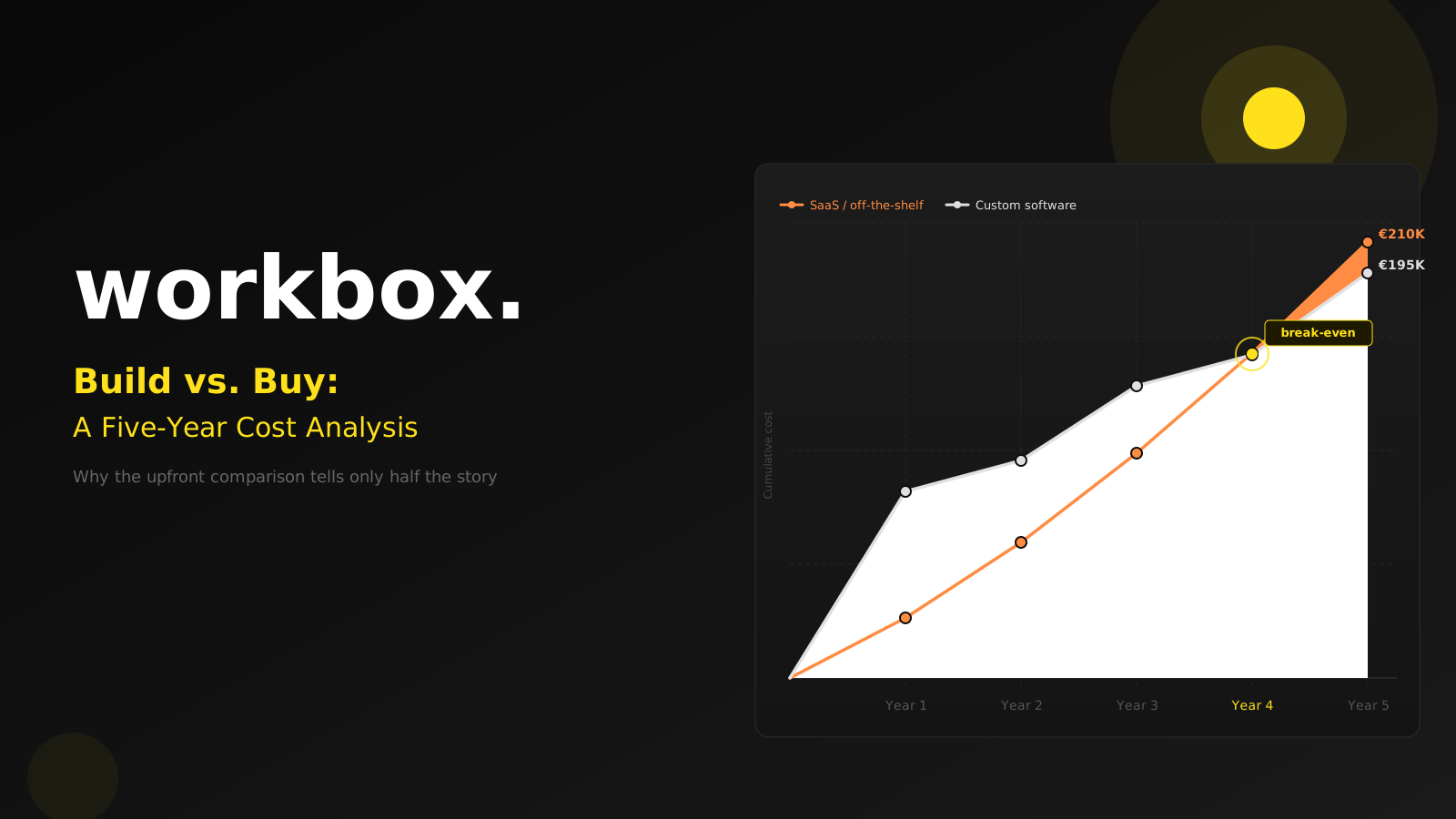
| SaaS (80 users, growing) | €30K | €36K | €42K | €48K | €54K | €210K |
| Custom software | €90K (build) | €15K | €35K | €15K | €40K | €195K |
These are illustrative — real numbers depend on the specific products and the complexity involved. But the pattern is reliable: the break-even for growing businesses typically falls between years three and five.
What the table cannot show: the custom system was built for your workflow. Every user decision, every report, every integration was designed around how your business actually operates. The SaaS product was not.
Scenario 3: Specialised process or competitive differentiation
When the process is genuinely specialised — a production management system for a particular manufacturing workflow, a client portal built around a service model nobody else offers, a logistics platform with requirements specific to your industry — off-the-shelf cannot close the gap regardless of pricing tier.
Here, the cost comparison matters less. The question is not whether custom software pays back in cost terms. It is whether the business capability it enables creates value that no available product can match.
These are the projects where the investment case is clearest — not because the five-year cost is lower, but because the alternative is simply not viable.
What the cost comparison leaves out
Even the most thorough five-year cost model omits several factors worth considering.
Competitive differentiation. Software that does exactly what your business does — and nothing else — can become a genuine operational advantage. Off-the-shelf tools give every competitor access to the same capabilities. Custom software can tilt the field.
Data ownership and portability. With custom software, you own your codebase and your data outright. With SaaS, you are a tenant. If the vendor changes pricing, discontinues the product, or is acquired, your options are constrained. The dependency is easy to underestimate when things are going well.
Process fit and adoption. When software fits the process rather than the other way around, people use it correctly and fully. The productivity benefit of well-designed, tailored software is real — and it rarely shows up in a spreadsheet comparison.
Technical debt. Stitching together multiple off-the-shelf tools with integrations and workarounds creates complexity that accumulates over time. At a certain point, maintaining and extending that stack costs more than a purpose-built replacement would have.
How to run this analysis for your own business
The five-year comparison is worth doing seriously before any major software decision. A straightforward approach:
Step 1: Calculate your actual current SaaS costs. Include every tool in the stack, every add-on, every integration service, every API fee. Most businesses find this number is meaningfully higher than they expected.
Step 2: Project how those costs will grow. At your current trajectory, how many users will you have in three and five years? What does that mean for per-seat pricing across each tool?
Step 3: Estimate your workaround and integration costs. How much time do your team members spend on manual processes that a well-designed system would automate? What does that time cost in salaries?
Step 4: Get a real estimate for custom software. Not a rough ballpark, but a proper scoping exercise with a development partner. This should typically be offered at no cost, and it will give you a credible basis for comparison.
Step 5: Compare at year one, year three, and year five. The picture is different at each horizon. If custom software reaches break-even by year four, and your business will be running the same systems in year eight, the long-term decision is straightforward.
The goal is not to find a reason to build. It is to make a decision based on the full picture — one that your business can stand behind over a five-year horizon, not just the next quarter.
Want to run this calculation for your specific situation? Get in touch — we will work through the numbers with you honestly, and if off-the-shelf is genuinely the better answer, we will tell you so.