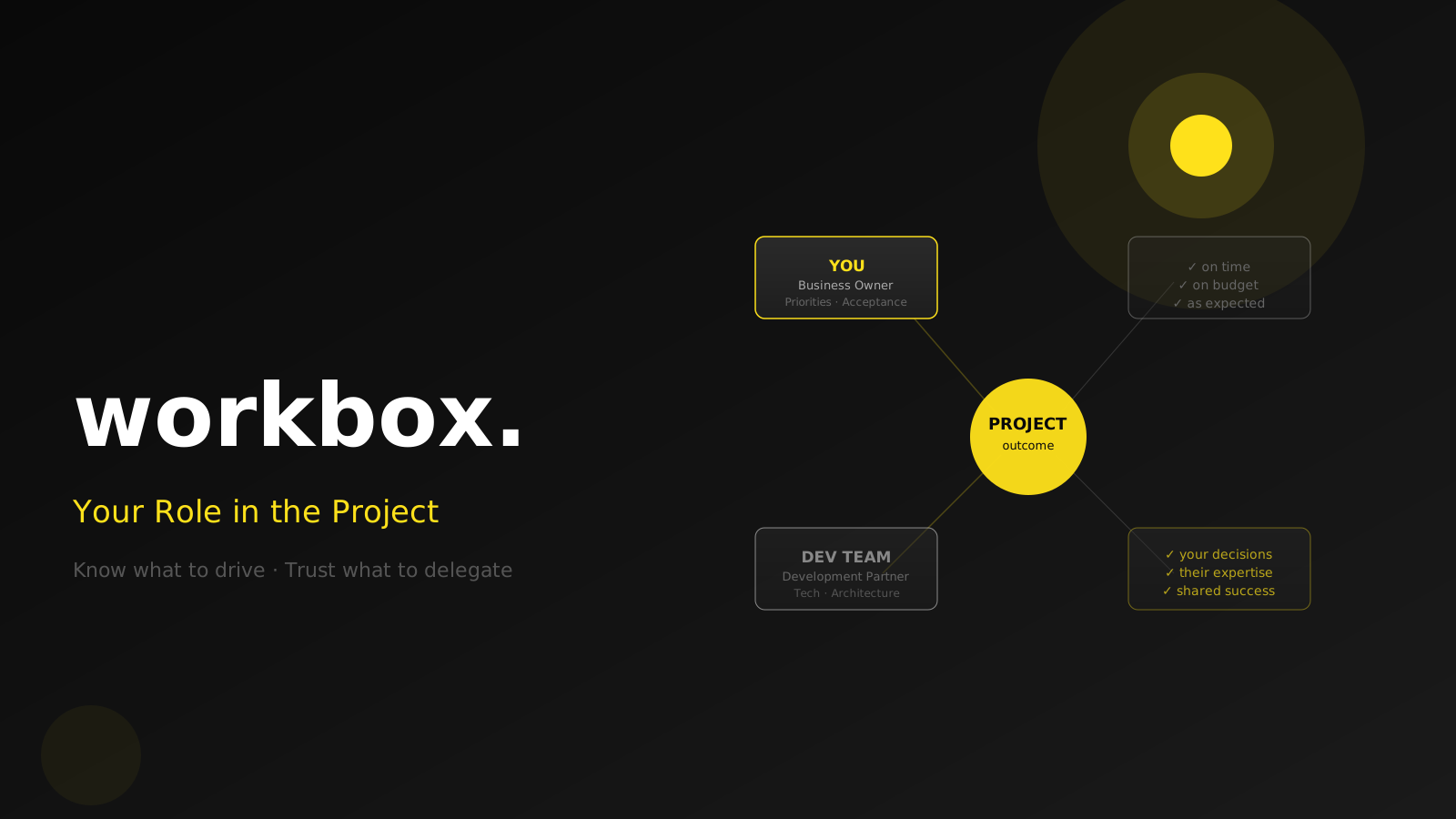
You have agreed on scope, signed the contract, and the development team has started work. At this point, many business owners find themselves asking a question they did not expect: what am I actually supposed to do now?
Some clients go quiet — trusting the team completely, only to surface weeks later to find the project has drifted. Others do the opposite: sending daily messages, questioning every design choice, and introducing new requirements in the middle of a sprint. Neither approach works.
There is a middle path — and it is worth understanding before development begins, not after the first friction appears.
Why your involvement matters more than you think
Software development companies are experts at building software. They are not experts at your business. The gap between those two things is where most projects run into trouble.
Your developers can write code that works perfectly and still build something that does not solve the right problem — if no one with business knowledge is actively guiding the decisions. That person is you. You cannot delegate your way out of this responsibility, because the domain expertise lives with you.
This does not mean you need to be a technical person. It means you need to be an available, informed, and decisive business partner throughout the project.
The decisions that only you can make
Some decisions look technical but are fundamentally about your business. These require your input, not the developer's judgment.
Priority. When the scope needs to be adjusted — because something took longer than expected, or a new requirement appears — someone needs to decide what matters most. That is a business decision, not a technical one. If your development team is asking for priority guidance and not getting it, the project will either stall or proceed on assumptions you may not agree with.
Business logic. How does your pricing work? What are the exceptions to your standard process? When does a customer get flagged for manual review? These rules live in your business, often in people's heads rather than any document. Development teams need them to be explicit — and the only way to extract them is to involve the people who know them.
Acceptance. When the team shows you a completed feature, you are the only person who can say whether it actually does what the business needs. Technical correctness is the team's responsibility. Business correctness is yours. These are not the same thing.
Risk tolerance. Trade-offs come up in every project — between speed and robustness, between features and cost, between ideal architecture and working product. Your team can present the options, but the decision belongs to you.
How to stay involved without slowing things down
Effective client involvement is about timing and structure, not volume. A client who is responsive and clear creates far fewer delays than one who is disengaged.
Show up to sprint reviews. If your team works in sprints (typically two-week cycles), there will be a regular demonstration of completed work. Attend these. They are the fastest way to spot misunderstandings early — when they are cheap to fix — rather than late, when they are not.
Respond to questions quickly. Development teams get blocked by unanswered questions. A decision that takes a week to reach you can cause a week of lost time. Most questions are not difficult — they just need someone with authority to give a clear answer. A fast, imperfect answer is almost always better than a slow, perfect one.
Designate a single point of contact. If multiple people in your organisation have opinions about the project — which is normal and healthy — decide in advance who is authorised to make final calls. Conflicting instructions from different stakeholders are a significant source of delay and rework.
Separate feedback from instructions. When reviewing completed work, there is a difference between "I noticed an issue with this" (feedback) and "please change this to do X instead" (instruction). Both are legitimate, but they should be communicated clearly so the team can respond appropriately.
What you can safely leave to the team
Part of getting the most from a development partnership is trusting the team with the things that are genuinely their domain.
Technology choices. Which framework, database, or deployment infrastructure is best for your system is a technical question. Your team should explain the rationale if asked, but you do not need to approve these decisions in detail. Interfering with technology choices based on what you have heard elsewhere is a common way to introduce problems you did not intend.
How tasks are divided and sequenced. The order in which features are built, and how the work is split among developers, is a project management and engineering question. The team knows what has dependencies on what, and what builds most efficiently on what has already been done.
Code quality and testing. How the code is structured internally, how it is tested, and what standards it follows are the team's responsibility. You should expect good practices — and hold the team accountable if there are signs of systematic quality problems — but reviewing code line by line is not a useful client activity.
Design details within agreed guidelines. If you have provided a brand guide or design direction, the team can make decisions within that framework without your approval on every small choice. Over-approving design creates bottlenecks without improving outcomes.
The most common client-side delays
There are a handful of recurring patterns that slow projects down from the client side. Knowing them in advance is the best way to avoid them.
Unavailability during critical decision points. Some decisions genuinely require a meeting or a detailed conversation, not just a quick reply. If the client is hard to reach during these moments, work either stops or proceeds on assumptions. Both outcomes are costly.
Scope additions during development. Ideas emerge during development — that is natural. The mistake is treating them as immediate additions to the current build rather than additions to a future phase. Every scope change mid-build disrupts the team's planning and usually costs more than the same change would in the next phase.
Delayed acceptance testing. Completed features need to be reviewed and accepted (or flagged for correction) in a timely way. If acceptance testing falls weeks behind, the team may have built further work on top of something that has not been approved — creating cascading corrections.
Changing the brief after sign-off. This happens more often than it should. Signed requirements get revisited, approved designs get redesigned, and confirmed decisions get reversed. Every reversal has a cost. If you are genuinely unsure about a requirement, it is worth resolving that uncertainty during discovery rather than partway through build.
What good collaboration actually looks like
The clients who end up with the best outcomes are not those who understand software — they are those who understand their own business and are willing to engage consistently throughout the project.
They show up to reviews, give clear feedback, make decisions in reasonable time, and trust the team with technical choices while staying close to business outcomes. They tell the team early when something has changed, rather than hoping it will not matter.
The relationship between a business owner and a development team works like any good working relationship: it needs clear communication, mutual respect for each other's domain, and enough structure to keep things on track.
When those elements are in place, projects tend to go well. When they are not, even technically excellent teams struggle to deliver what the business actually needs.
Getting the relationship right is worth the effort. The investment you make in understanding your role — and showing up to play it — pays back many times over in a project that lands where you needed it to.