One of the first questions every client asks us is: "How much will it cost?"
It is the right question to ask. But it is also one that cannot be answered honestly without knowing more about the project. Custom software development is not a commodity — the price depends heavily on what you are building, how complex it is, and how you approach the process.
This article explains the main factors that drive cost, what realistic price ranges look like, and how to approach the budgeting conversation in a way that leads to better outcomes.
Why there is no standard price list
When you buy a SaaS product, the pricing is simple: you pay a monthly or annual fee, often per user. The product is already built; you are paying for access.
Custom software works differently. You are not paying for access to something that exists — you are paying for something to be created specifically for your situation. That means the cost is shaped by the scope, the complexity, and the decisions made along the way.
Two companies can both need a "customer management system" and end up with projects that cost five times what the other cost — because one requires a simple database with a clean interface, while the other needs real-time integrations, complex approval workflows, a mobile app, and compliance with specific industry regulations.
This is not a problem. It is just how bespoke work functions. The goal is to make sure you understand what is actually driving the cost in your case.
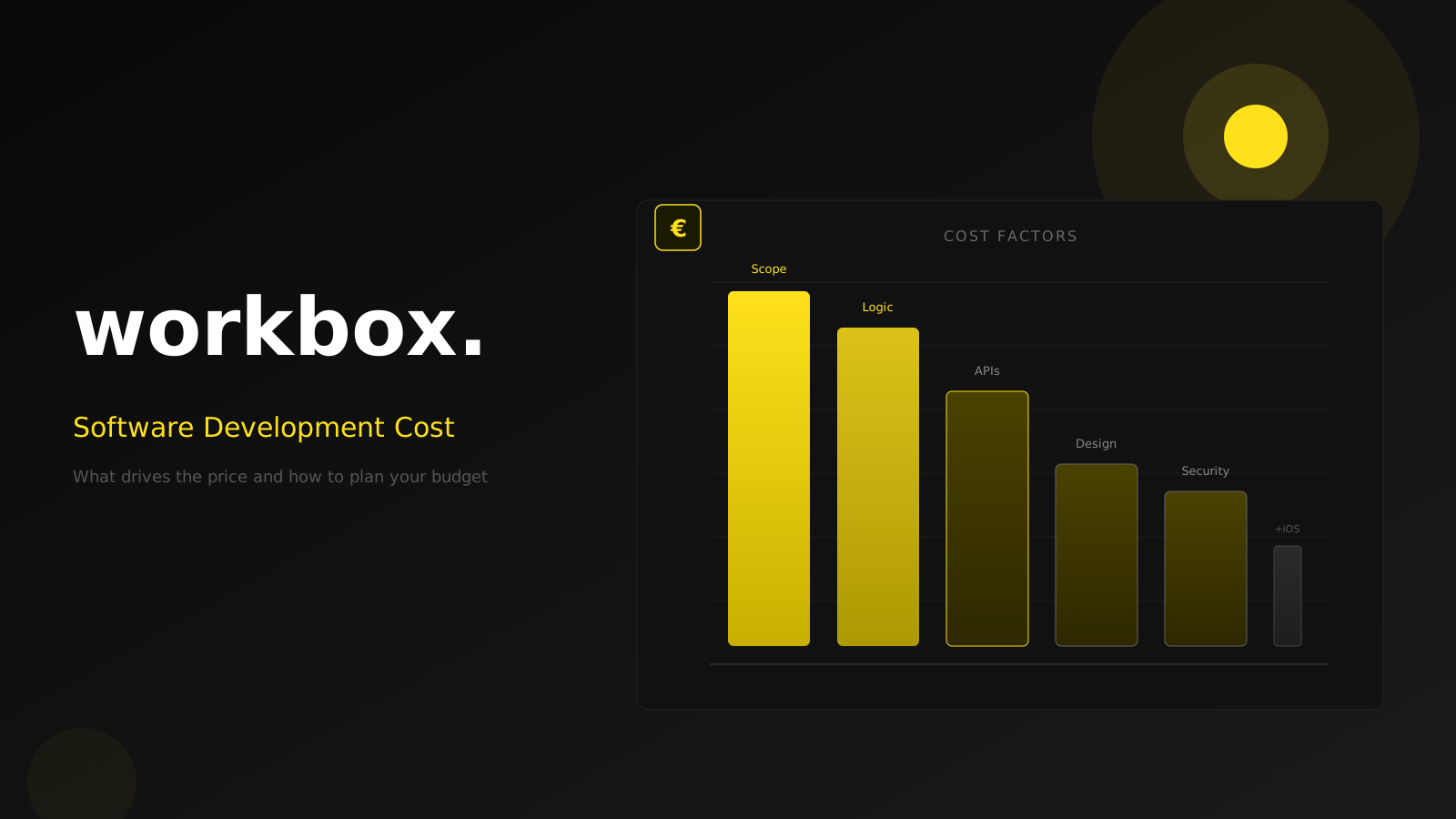
The main factors that affect price
1. Scope and number of features
The most obvious driver: the more the software needs to do, the more it costs to build. Every feature has a design phase, a development phase, a testing phase, and needs to be integrated with everything else.
The key insight here is that scope is negotiable. A well-managed project identifies which features are essential for the first release and which ones can come later. Launching with a focused set of core features is almost always cheaper, faster, and safer than trying to build everything at once.
2. Complexity of the logic
Not all features are equally complex to build. A simple form that saves data to a database takes a few hours. A system that calculates insurance premiums, checks regulatory limits, applies customer-specific rules, and flags exceptions for manual review can take weeks — even if it looks like "just a form" from the outside.
Business logic — the rules that govern how your business actually works — is often the most expensive part of a software project. The more rules, exceptions, and edge cases, the more time it takes to get right.
3. Integrations with other systems
Modern businesses run on multiple tools: accounting software, CRM systems, payment providers, shipping platforms, ERP systems, legacy databases. If your custom software needs to communicate with any of these, each integration adds cost.
Some integrations are straightforward — a well-documented API with a clear standard. Others are complex — an old system with no documentation, inconsistent data formats, or a provider that charges for API access. The number and quality of integrations is one of the biggest hidden cost drivers in software projects.
4. User interface and user experience design
Software that users interact with directly — whether employees or customers — needs a well-designed interface. A clean, intuitive design takes time and expertise.
Internal tools that only a small team uses can often be functional with a simpler design approach. Customer-facing applications, on the other hand, require significantly more investment in user experience — because poor UX directly affects adoption rates and conversion.
5. Security and compliance requirements
If your software handles sensitive data — personal information, medical records, payment data, financial information — you need to meet specific security standards. GDPR compliance, encrypted storage, role-based access controls, audit logs, and secure authentication all add to the scope.
Industry-specific regulations (finance, healthcare, legal) add another layer. This is not optional cost — it is cost that protects your business and your customers.
6. Number of platforms
Do you need a web application only, or also a mobile app for iOS and Android? Each additional platform multiplies the surface area of the project. Modern approaches like progressive web apps or cross-platform mobile frameworks can reduce this cost, but the basic principle holds: more platforms means more work.
7. Post-launch maintenance and support
The initial build is not the end of the investment. Software needs to be maintained: security updates, infrastructure monitoring, bug fixes, and ongoing improvements based on real-world usage.
Some clients budget for a dedicated ongoing support contract. Others prefer to plan improvements project by project. Either way, the total cost of ownership extends well beyond the initial launch.
What realistic price ranges look like
Precise numbers without context are misleading, but here are broad reference points based on typical project types:
Simple internal tools (a dashboard to replace a spreadsheet, a simple workflow application): these projects typically fall in the range of lower five figures. They have limited scope, straightforward logic, and minimal integrations.
Mid-complexity business applications (a customer portal, an order management system, a reporting tool with multiple data sources): these typically run in the middle five-figure range, depending on the number of integrations and complexity of the business logic.
Complex platforms and systems (a multi-tenant SaaS product, a platform connecting multiple parties, a system with complex rules and regulatory requirements): these projects run into six figures and often beyond. They require more planning, more development time, and more careful architecture.
These ranges are meant to give you a starting framework — not a quote. Every serious project requires a proper analysis before a reliable estimate can be given.
The hidden costs that surprise clients
Beyond the development itself, there are costs that many clients do not anticipate:
The analysis phase. A proper requirements analysis before development starts is an investment, not a formality. It typically costs between 5–15% of the total project cost, but it prevents scope creep, misaligned expectations, and costly rework later.
Infrastructure and hosting. Your software needs somewhere to run. Cloud hosting, domain names, SSL certificates, email delivery services — these are recurring costs that should be planned for from the start.
Testing and quality assurance. Good software is tested properly. This is not optional if you want something that actually works reliably. Testing adds to the upfront cost but prevents much larger costs from production failures.
Training and documentation. People need to know how to use the new system. Internal training sessions and clear documentation require time and effort — especially when the software is replacing established manual processes.
Migration and rollout. If the new software replaces an existing system, data needs to be migrated, people need to be onboarded, and the transition needs to be managed carefully. This phase is often underestimated.
How to approach the budgeting conversation
Rather than asking "how much does it cost?" without context, come to the conversation prepared with:
A clear description of what the software needs to do. Not a technical specification — just a plain-language explanation of the problem you are solving and the main things the system needs to handle.
An honest assessment of your constraints. Budget ceiling, timeline requirements, and any non-negotiable features. The more clearly you communicate these upfront, the more useful the feedback you will get.
Openness to phasing. The best software projects are rarely built all at once. A clear, prioritised feature roadmap allows you to start smaller, validate what you have built, and invest further based on real results.
An understanding that the cheapest quote is rarely the best value. A low quote that does not account for proper analysis, adequate testing, or realistic integrations will cost you more in the long run — through rework, delays, and software that does not actually meet your needs.
What a reliable development partner will do
A trustworthy team will not give you a firm quote after a thirty-minute call. They will:
- Ask detailed questions about your processes, your constraints, and your goals
- Suggest a scoping or analysis phase to define the project properly before committing to a full budget
- Explain what is driving the cost and what trade-offs are available
- Be honest when your budget and your requirements do not match — and help you find a path that works
If a team gives you a precise number very quickly, with minimal questions, treat that as a warning sign. Precise quotes based on vague requirements are usually wrong — and the client ends up paying for that disconnect.
If you are trying to get a realistic sense of what your project might cost, get in touch. We will ask the right questions and give you an honest picture of what to expect — including what we can do within your budget and what would require a different approach.