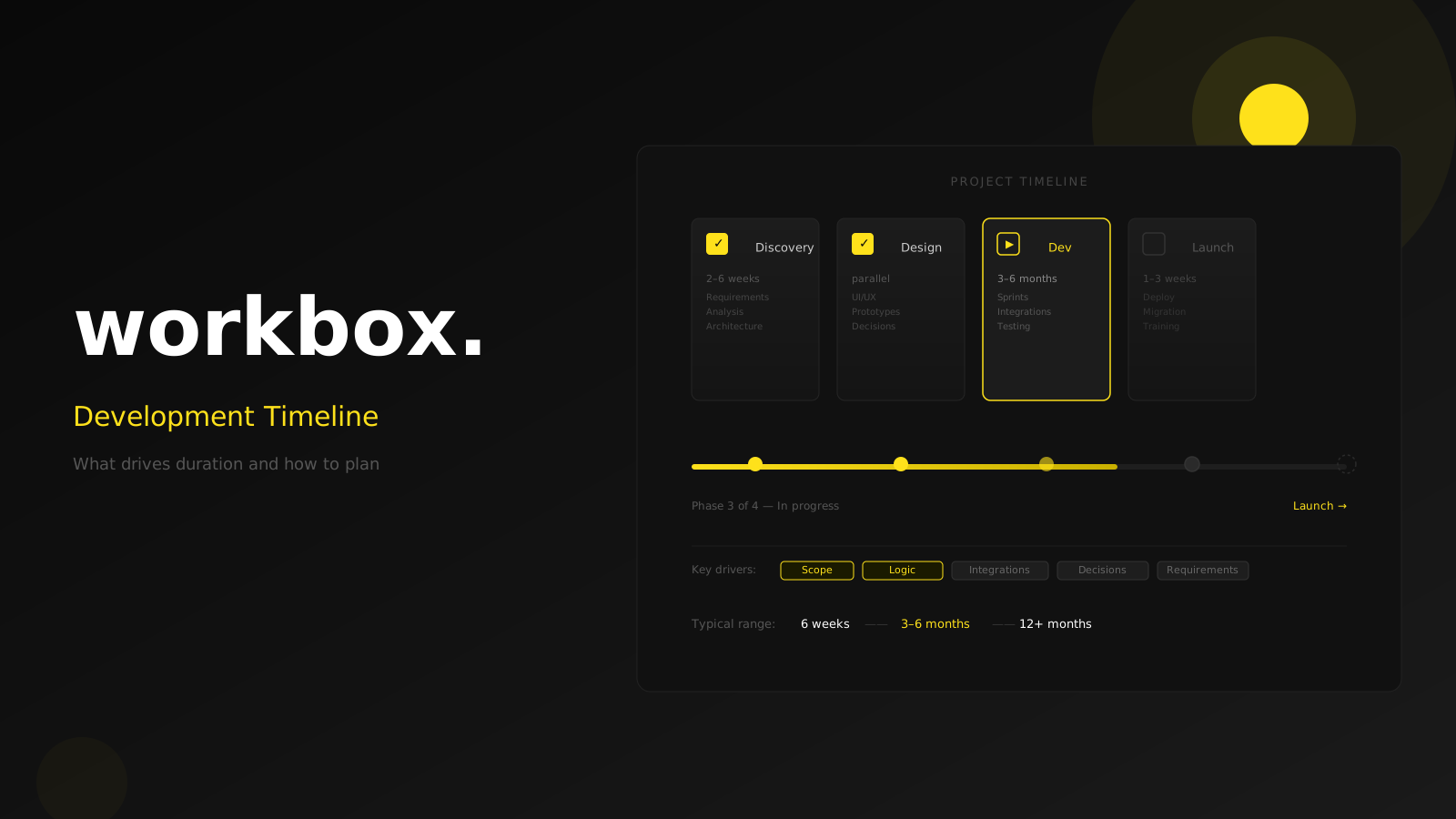
After "how much will it cost?", the second question every client asks is: "How long will it take?"
It is the right question. And like the cost question, it cannot be answered honestly without knowing considerably more about what is being built. But that does not mean you have to go into a project blind. There are clear factors that determine how long software development takes — and understanding them will help you plan more realistically, avoid the most common disappointments, and have far more productive conversations with any development company you speak to.
Why timelines are so difficult to predict
Software development involves solving problems that have not been solved before — at least not in exactly this configuration, for exactly this business. Even experienced developers regularly encounter surprises: integrations that are more complex than expected, business requirements that turn out to be contradictory, edge cases that only emerge once real data enters the system.
This is not an excuse for poor planning. It is the reason why honest timeline estimates require a proper understanding of the project before they can be given. The companies that quote you a fixed timeline after a thirty-minute call are not necessarily more organised — they are more likely to be avoiding the complexity rather than accounting for it.
What actually drives how long a project takes
The scope and number of features
The most direct factor: the more the software needs to do, the longer it takes to build. Every feature needs to be designed, developed, tested, and integrated with the rest of the system. A focused scope with a well-defined set of core features will always deliver faster than a broad scope where everything is treated as equally important.
The discipline to prioritise ruthlessly — to decide what goes into the first version and what comes later — is one of the most valuable things a client can bring to a project. It is also one of the hardest, because it means making real choices rather than deferring them.
The complexity of the underlying logic
Not all features take the same time. A form that captures customer information and sends an email takes a few hours to build. A pricing engine that applies discount rules, checks inventory levels, calculates tax by jurisdiction, and flags orders for manual review can take weeks — even though both might look like "just a form" from the outside.
The business logic embedded in your processes — the rules, exceptions, and special cases that make your operation work — is often what takes the longest to build correctly. The more nuanced your business rules are, the longer it takes to translate them into working software.
Integrations with existing systems
Most new software does not exist in isolation. It needs to connect to your existing tools: accounting software, CRM, inventory systems, payment processors, logistics platforms, data warehouses. Each integration adds to the timeline.
Well-documented, modern APIs can be integrated relatively quickly. Legacy systems, undocumented internal databases, and third-party platforms with poor API design can each add weeks. The number and quality of integrations is one of the biggest hidden drivers of project duration.
The quality of the requirements
Here is a factor that is entirely within the client's control: how clearly the project is defined before development starts. Projects where requirements are vague, frequently changing, or discovered during development consistently take longer than projects where the scope is well-defined upfront.
This does not mean you need a perfect specification before anything can begin. It means investing time in a proper analysis phase — working with the development team to map out what needs to be built before the build begins. That investment pays back multiple times over in speed and accuracy during development.
Team size and structure
A larger team does not always mean a faster project. Software development is not like moving boxes — adding more people to a complex project can actually slow it down as communication overhead increases and work needs to be carefully coordinated. The right team size depends on the nature of the project, and good development companies are honest about this trade-off.
Review and approval cycles
Projects where the client is available, engaged, and can make decisions quickly move faster. Projects where feedback takes two weeks, where requirements need internal sign-off from multiple stakeholders, or where key decisions keep getting deferred will always run longer. This is not a criticism — it is a planning reality. Building in adequate time for reviews and decisions is as important as estimating the development work itself.
What realistic timelines look like
Precise numbers without context are unreliable, but here are broad reference points based on project types:
Simple internal tools (a dashboard to replace a spreadsheet, a simple approval workflow, a basic reporting interface): these projects typically take between six and twelve weeks from project kick-off to deployment — assuming a clear scope and an engaged client.
Mid-complexity business applications (a customer portal, an order management system, an internal operational tool with multiple user roles): these projects typically run three to six months. The range reflects how much complexity lives in the business logic and integrations.
Complex platforms and systems (a multi-tenant SaaS product, a system that serves multiple organisations, a platform with complex rules and regulatory requirements): these projects realistically take six to twelve months or more for the initial version. They require more planning, more careful architecture, and more rounds of refinement.
These ranges assume a phase of analysis and design before development begins. Skipping that phase does not eliminate the time it represents — it just moves the problems it would have caught into the middle of development, where they cost far more to resolve.
The phases that make up the total timeline
A typical project moves through several phases, each of which takes time:
Discovery and analysis — understanding what needs to be built, why, and for whom. Mapping out integrations, edge cases, and business rules. Producing a specification that the development team can work from. This phase typically takes two to six weeks depending on project complexity.
Design — translating the requirements into user interface designs and architectural decisions. This runs partly in parallel with analysis and continues into early development.
Development — the actual building. This is usually broken into iterations (sprints), with working software being produced at regular intervals rather than all at once.
Testing — both automated testing during development and structured quality assurance at key milestones. This is not a phase that happens only at the end; it runs throughout.
Deployment and rollout — moving the software to production, migrating data if needed, training users, and managing the transition from old processes to new. This phase is often underestimated in timeline planning.
Post-launch stabilisation — a period of monitoring, small fixes, and adjustments based on real-world usage. This is a normal and expected part of any software project.
Common reasons projects run over schedule
Most timeline overruns come down to a handful of predictable causes:
Unclear or changing requirements. When what needs to be built keeps evolving, the timeline follows. Some change is inevitable and healthy — but requirements that fundamentally shift partway through development are expensive.
Underestimated integrations. The third-party API that was supposed to take two days takes three weeks. The legacy database has no documentation. The payment provider has a compliance review that takes a month. Integration complexity is systematically underestimated in early project planning.
Delayed decisions. Every time the client cannot confirm a design decision or approve a milestone promptly, development stalls. Small delays compound into significant schedule drift.
Scope expansion without timeline adjustment. Adding features to the scope without acknowledging that they add time is one of the most reliable ways to turn a six-month project into a twelve-month one. Every addition needs to be weighed against the timeline explicitly.
Insufficient testing time. Cutting testing phases to recover a slipping schedule creates a different problem: bugs in production that require emergency fixes, rollbacks, and unplanned work that costs more time than testing would have taken.
How to plan your project timeline realistically
When working with a development company, push for specificity on a few things:
A phased plan, not a single end date. A project that is broken into clear phases — each with defined deliverables and milestone reviews — gives you real visibility into progress and early warning when something needs to change.
Explicit assumptions. Every estimate is based on assumptions about scope, integrations, and decision-making speed. Ask what assumptions are embedded in the timeline and what would cause them to change.
Buffer for the unexpected. Experienced teams build contingency into their estimates. A plan that accounts only for things going well is not a realistic plan.
Honest assessment of dependencies. What needs to happen on your side for the project to stay on track? Which stakeholders need to be available, and when? What decisions have not yet been made? These dependencies belong on the project timeline.
If you are trying to get a realistic sense of how long your project might take — or want to understand what factors in your situation would most affect the timeline — get in touch. We will work through the specifics with you and give you an honest picture of what to expect.