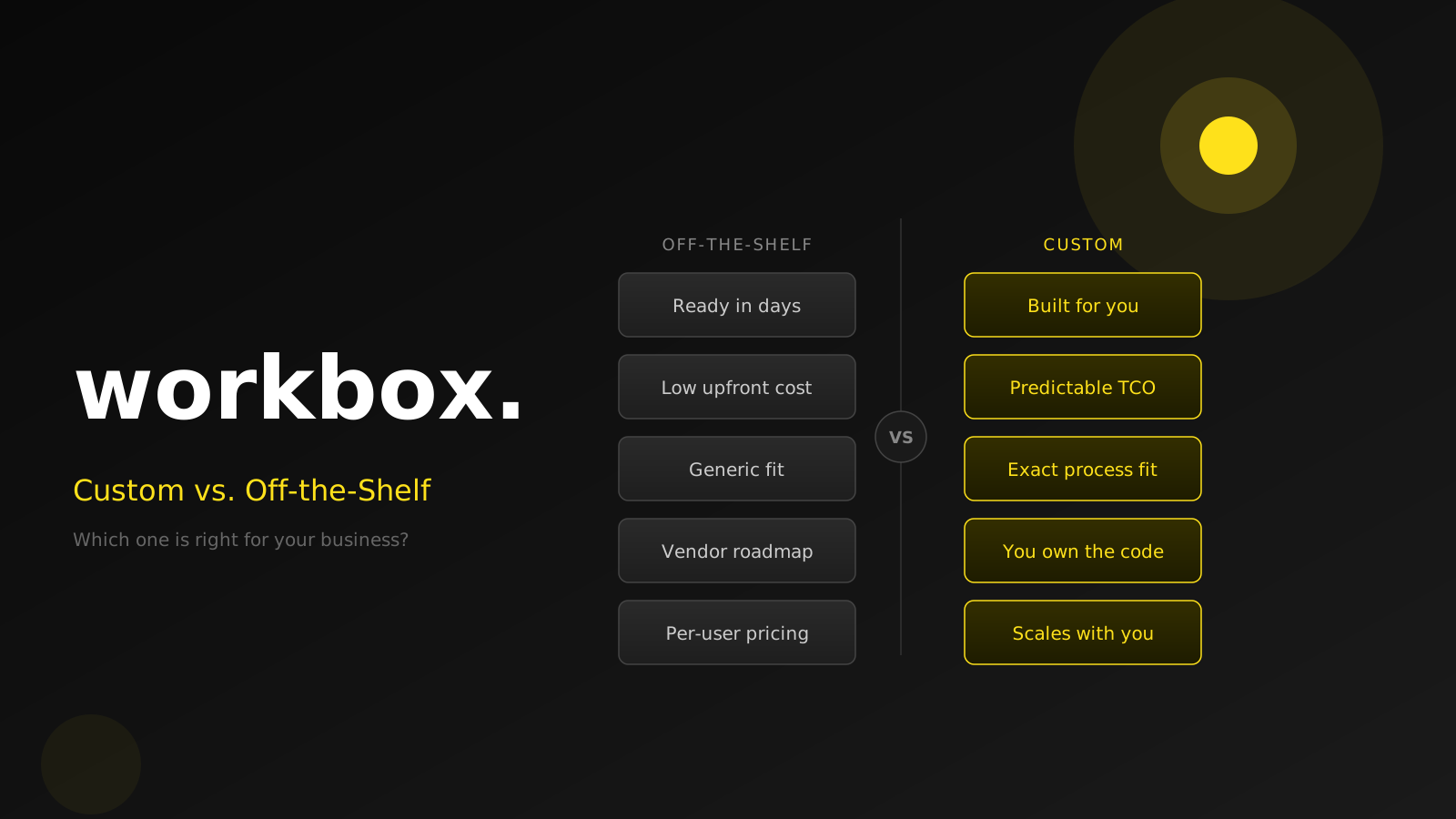
Every growing business eventually reaches a fork in the road: buy an off-the-shelf tool or build something tailored to the way you actually work?
Both paths have genuine merit. But too many companies default to one or the other without thinking it through — and end up paying for that mistake for years.
This guide will help you make the right call.
What we mean by "off-the-shelf" software
Off-the-shelf software is a ready-made product designed to serve many different companies. Think accounting tools, CRM systems, project management platforms, or HR software. You pay a subscription (or a one-time licence), set it up, and you are running within days.
The appeal is obvious:
- Low upfront cost — you pay for what already exists
- Fast deployment — no months of development
- Ongoing updates and support from the vendor
- Proven reliability — thousands of other companies use it
The catch is just as obvious: it was built for a wide range of users, not for you. To fit your workflow, you end up bending your process to match the software — not the other way around.
What custom software actually means
Custom software is built specifically for your business. It models your processes exactly as they run, integrates with the systems you already have, and does what you need — nothing more, nothing less.
Custom development is not the same as "expensive" or "slow." A well-scoped project can be delivered in weeks, not years. The difference is that every decision — architecture, features, interfaces — is made for your specific situation.
When off-the-shelf is the right answer
For many needs, a standard product is absolutely the right choice. You should strongly consider it when:
Your process is standard. If the way you handle invoicing, time tracking, or customer support looks similar to hundreds of other companies in your sector, a market-leading product will likely serve you well.
You are early-stage. If your business model is still evolving, locking into a custom build before you know what you need is risky. Start with proven tools and build custom later.
Your budget is tight short-term. A subscription tool gets you running now. Custom development requires upfront investment that pays off over time.
The vendor ecosystem is strong. A good off-the-shelf product integrates with dozens of other tools, so you can build a solid stack without writing a line of code.
When custom development pays off
The economics flip when one or more of these apply to your situation:
Your process is genuinely different
If your workflow has specific steps, approval chains, or logic that no standard product supports well, you will spend more time working around the software than using it. Those workarounds — manual steps, spreadsheets on the side, copied data — have a cost that is easy to underestimate.
You are paying for features you will never use
Enterprise software is priced for enterprise needs. If you are using 15% of a platform's features and paying for 100%, the maths often start to favour something built specifically for that 15%.
You need integrations that do not exist
Every integration that does not come out of the box needs to be built by someone, maintained, and updated when either system changes. Over time, a patchwork of integrations can cost more than building a coherent system from scratch.
The software is becoming a constraint on growth
The most expensive kind of off-the-shelf software is the kind that stops your business from doing something it needs to do. When your system cannot support a new product line, a new market, or a new operational model — and there is no roadmap from the vendor — you are stuck.
You have competitive processes worth protecting
If the way you work is genuinely a source of competitive advantage, putting that process inside a generic tool means your competitors can buy the same tool and replicate your approach. A bespoke system keeps that logic proprietary.
The real cost comparison
The upfront numbers look obvious: a SaaS subscription costs much less to start than custom development. But the total cost of ownership over three to five years is often a very different picture.
| Factor | Off-the-shelf | Custom |
|---|---|---|
| Initial cost | Low | Medium–high |
| Monthly running cost | Ongoing per-user fees | Hosting + maintenance |
| Customisation cost | Workarounds + manual effort | Already in the build |
| Integration cost | Per-integration add-ons | Designed in from the start |
| Switching cost | High (when you outgrow it) | Low (you own the code) |
| Scaling cost | Usually per-seat or per-usage | Predictable |
Many clients who come to us have already spent two or three years on a standard product, accumulated significant workaround costs, and are now facing a painful migration anyway — except now the process has grown more complex and the data is harder to move.
Questions to ask before you decide
These five questions will clarify most situations:
-
How much of the standard product will we actually use? If the honest answer is less than 40–50%, dig deeper.
-
What will our workarounds cost us? Think in real hours per month, across every person who touches the process. Multiply by twelve.
-
What does this system need to integrate with? If the answer is more than two or three other tools, integration complexity adds up fast.
-
How much will our needs change in the next three years? If your business is growing fast or your model is shifting, flexibility matters more than it looks today.
-
Is this process a source of competitive advantage? If yes, ask whether it makes sense to run it inside a competitor's tool.
A realistic middle ground
Custom development does not have to mean building everything. Many companies find the right answer is a hybrid: use proven off-the-shelf products where they fit (accounting, email, HR basics), and invest in custom software only where the standard tools genuinely fall short.
At Workbox, we often help clients map exactly this boundary — what to buy, what to build, and in what order. Sometimes the honest answer is "the right SaaS product will serve you better." We would rather tell you that upfront than take a project that is not the right fit.
Not sure which way to go? Get in touch — we will help you think through the decision honestly, including whether custom development is actually the right move for your situation.