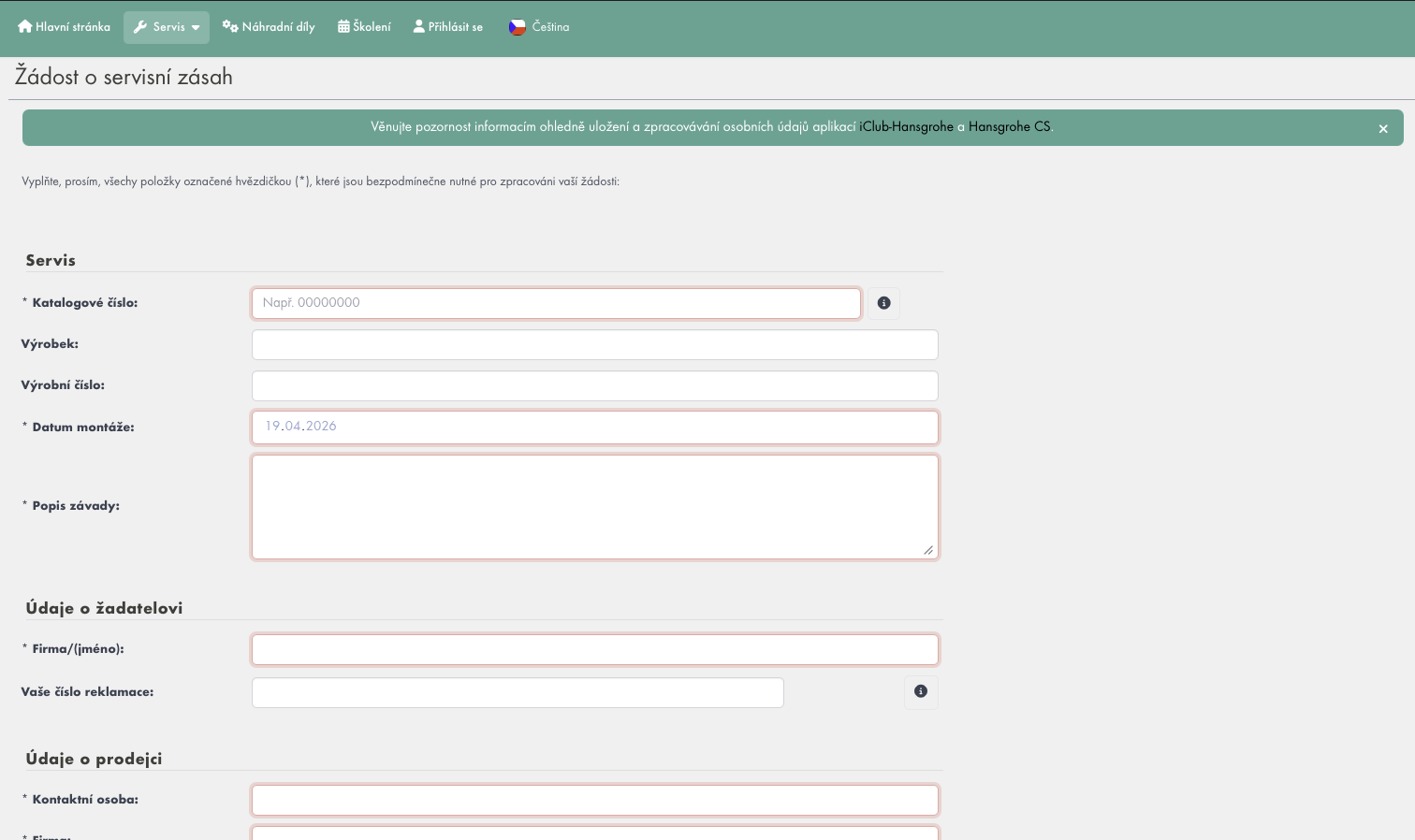
For Hansgrohe we designed and shipped iClub Hansgrohe — a complete platform for managing warranty and post-warranty service of premium sanitary ware across the Czech Republic. A customer reports an issue from the web or mobile, an algorithm assigns it to the best technician in the area, the tech resolves it in the field — even without signal — and the whole visit flows straight into SAP.
In this post we walk through the seven capabilities that made the system indispensable for Hansgrohe and their customers.
The problem: a warranty is a promise, not a marketing line
Hansgrohe manufactures premium sanitary ware and backs it with strong warranties — including a 30-day resolution policy for both warranty and post-warranty service requests. In practice that promise runs into the realities of field work:
- Customers rarely know the catalogue number of the part, and defect descriptions are vague.
- The technician has to guess the right spare part up front — a second visit breaks the SLA.
- A large share of end-users live in areas with poor cellular coverage (guesthouses, holiday homes, new builds).
- Field data used to be re-typed into SAP by hand — a 3–5 day lag was the norm.
The project goal was unambiguous: get 80% of cases from reported to resolved in under 7 days, and eliminate manual re-typing entirely.
1. Understanding the problem and the customer
Before a single line of code we spent four weeks in the field with technicians. We mapped the real steps of a typical visit — from the phone call and van prep through to signing the work order on the customer's iPad.
That uncovered some unexpected requirements:
- Technicians need large, high-contrast buttons — gloves, wet hands, bright bathroom lighting.
- Forms must be one-handed fillable — the other hand is often holding the part.
- Defect notes need favourite phrases as quick templates — "joint leaking", "perished seal", "stuck cartridge".
2. An algorithm to route each case to the right technician
Field diagnosis is fastest when the technician arrives with a hypothesis. We built a routing algorithm that weighs, before assignment:
- Geographic proximity and current technician workload,
- Specialisation (shower systems vs. kitchen mixers vs. AXOR),
- Historical success rate with similar defect types,
- Availability of the expected spare part in the technician's van.
As a result, technicians arrive with the right part on the first visit in 78% of cases.
3. A field mobile app with true offline mode
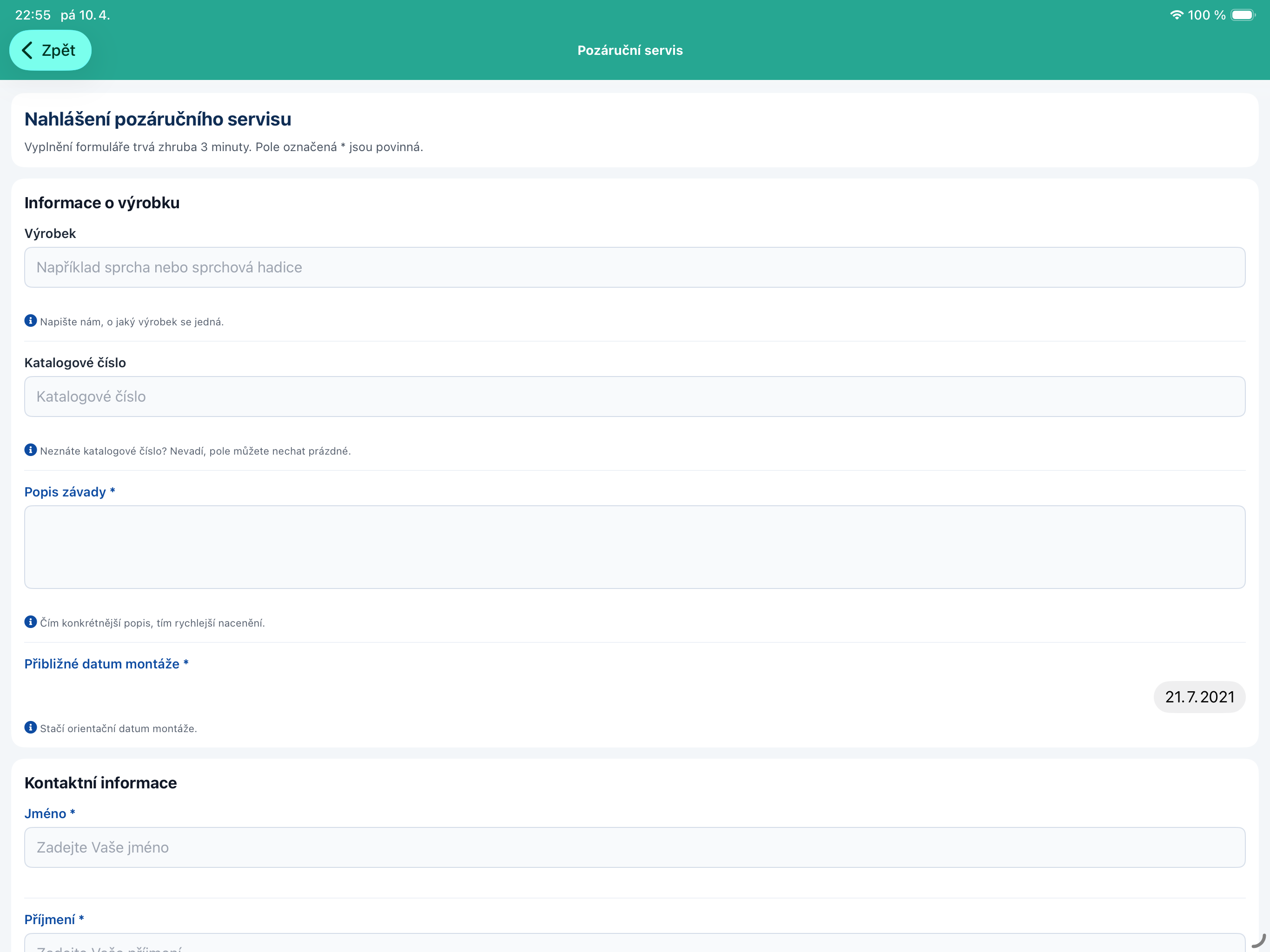
The core of the platform is iClub Hansgrohe — a mobile app the technician uses to drive their entire day: open cases, planned route, price book, spare parts, digital customer signature.
The critical capability is a fully offline mode. When a tech walks into the basement of a guesthouse with no signal, the app keeps working:
- A local replica of critical data (price book, parts catalogue, case history) syncs at the start of the day.
- Filled-in forms, photos and the customer signature persist locally.
- When connectivity returns, a deterministic merge runs against the backend — nothing gets silently overwritten by a colleague's concurrent edit.
A concrete example from production: a technician in a Krkonoše guesthouse replaces a shower hose, the customer signs off on the phone, three photos are taken. All offline. An hour later in the van, the bundle (JSON + binary attachments) uploads to the server and lands in SAP within 90 seconds.
4. Training module for the broader installer community
A large share of warranty claims aren't product faults — they're installation mistakes. So the platform ships with a training module: videos, interactive guides and quizzes for installers outside the authorised network.
After completing the module and passing a short test, installers earn a certificate. This reduces false claims and gives Hansgrohe a wider database of trained partners.
5. iPad admin module for spare-parts orders
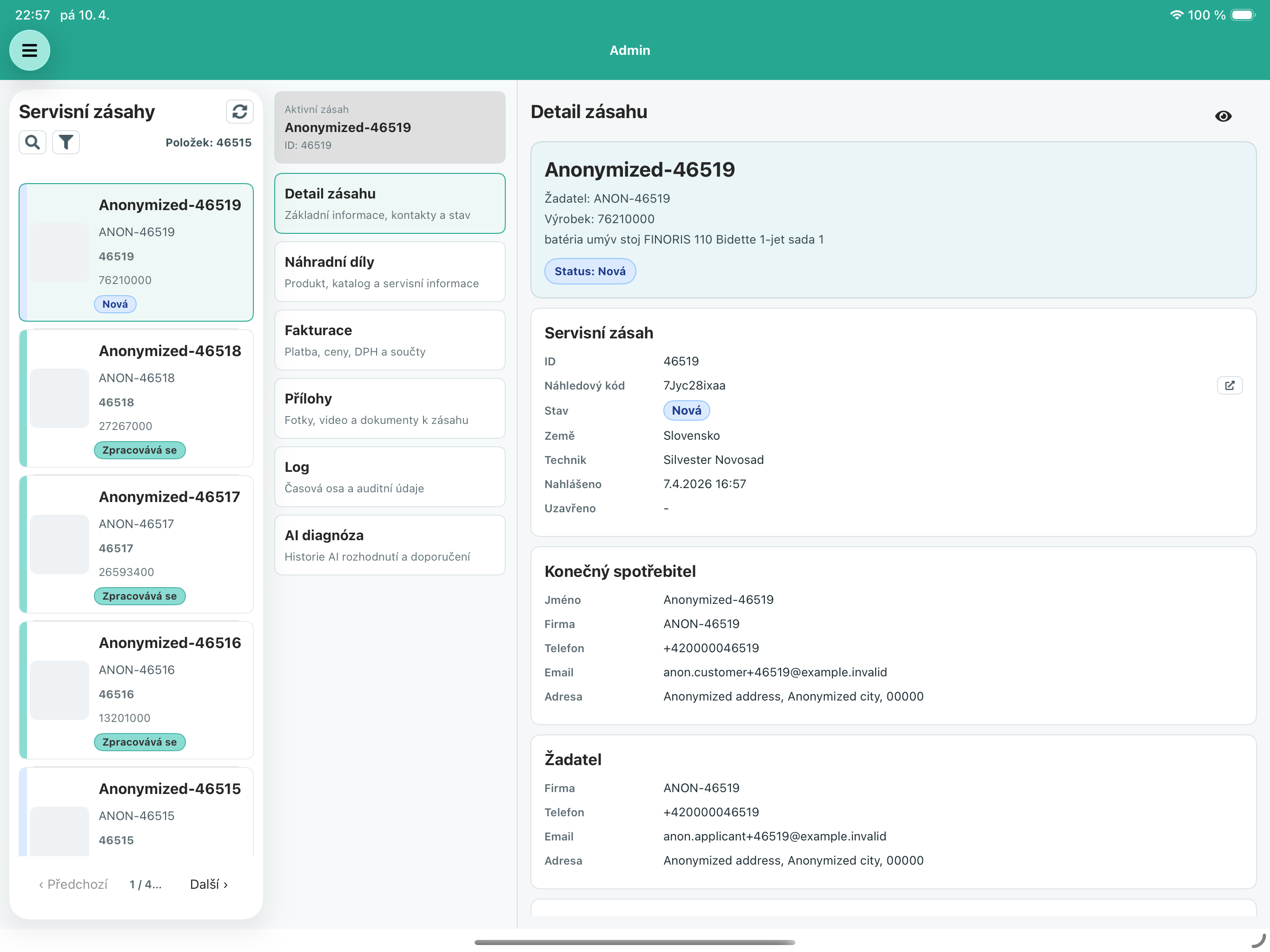
Service coordinators work primarily from an iPad — in the office and on the move. The admin module is designed tablet-first:
- Quick overview of open cases by status ("New", "Open", "To complete").
- Bulk spare-part ordering across cases — one click, one invoice.
- Two-tap quote approvals with a full audit history.
- News and announcements from HQ (new price books, app updates, reports from iClub events).
6. Import / export and SAP integration
Hansgrohe runs a large SAP ERP. Our platform had to integrate seamlessly in both directions:
- Import: product master data, spare-part catalogues, price books, business partners — daily sync via IDoc.
- Export: every closed case becomes a service order with labour, material and customer signature metadata.
The upshot: nobody re-types anything. Admin capacity saved: ~40 hours per week across the Czech branch.
7. AI diagnostic tool for warranty decisions
The most interesting module on the project. The AI assistant, on intake of a claim:
- Classifies the fault type from the description and photo (10 categories).
- Suggests the most probable spare part, linked to the catalogue.
- Estimates whether the defect is likely covered by warranty (product age, fault type, customer history).
A human always approves the final call, but the AI gives them a sharp first read. Agreement with the service specialist's decision sits at 93%, and the suggested part cut "return visits" by more than a third.
Results after year one
- Average resolution time dropped from 11 days to 5.2 days.
- 30-day SLA compliance: 98.4% (up from 81% before the project).
- Zero manual re-typing into SAP across the service team.
- Technician NPS up 22 points — the app made their day easier, not harder.
Looking at something similar for your business?
If you run warranty or post-warranty service, manage a field team, integrate with SAP or IBM Maximo, and want to bring AI into the loop — get in touch. The first consultation is no-commitment and free.