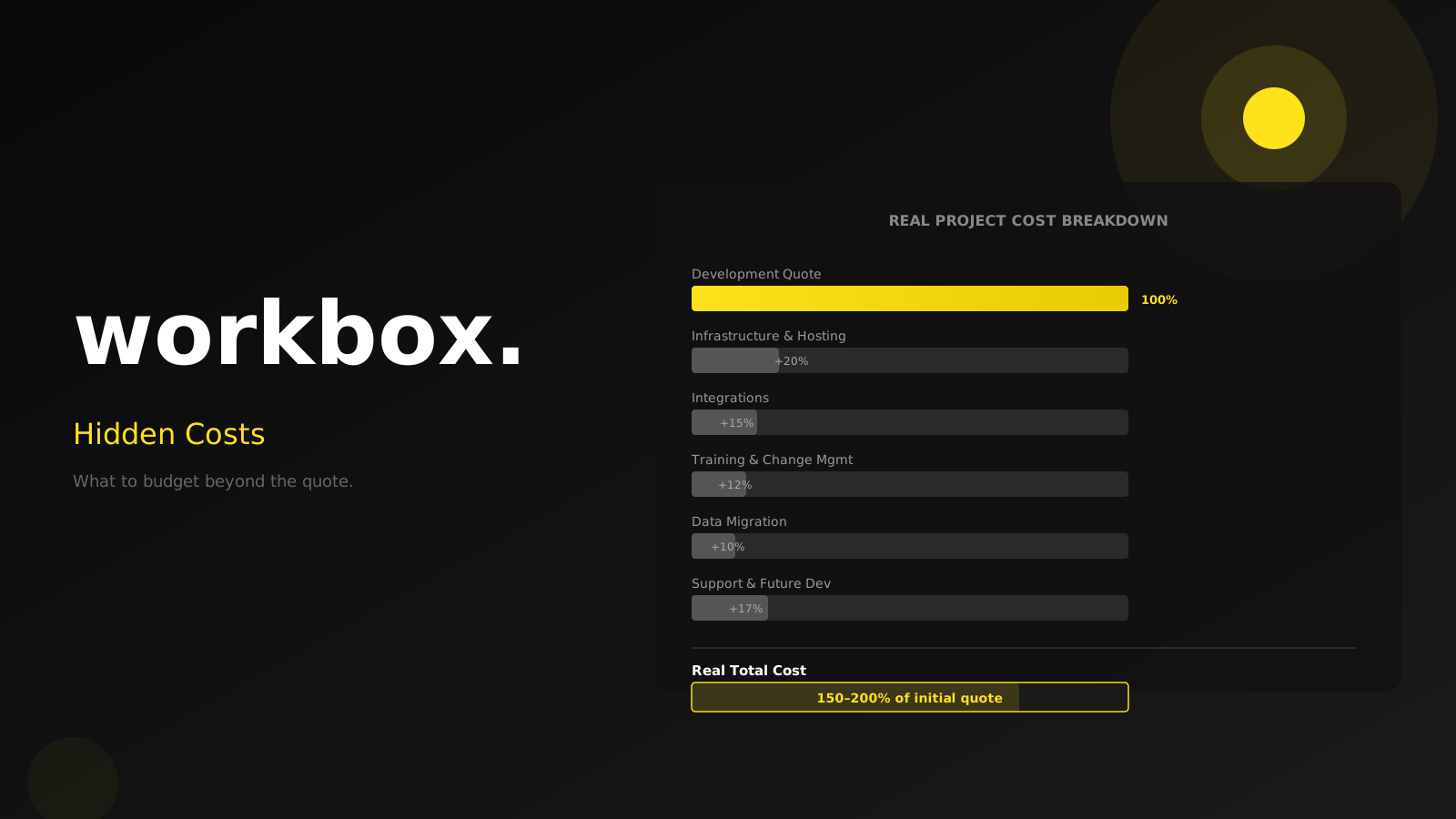
You have received a quote for custom software development. The number is larger than you expected, or perhaps smaller. Either way, there is something important to understand: the quote you are looking at covers only part of the real cost.
This is not a criticism of development companies. It is simply how software projects work. The development fee is the single largest line item, but it is far from the only one. Business owners who plan only for the development quote frequently run into budget shortfalls mid-project, or find themselves unprepared for costs that arrive after launch.
This guide walks through the costs that do not always appear in a development proposal — so you can plan for them before they arrive.
Infrastructure and hosting
Custom software needs somewhere to run. That somewhere costs money, and it costs money every month, not just once.
The infrastructure costs for a custom application depend on what the software does, how many users it has, and what reliability requirements you need. A lightweight internal tool might run on a small server for a modest monthly fee. A customer-facing platform that processes payments and handles peaks in demand might require a more substantial setup.
What to budget for:
- Cloud hosting: Services like AWS, Azure, or Google Cloud charge based on usage. Your development team should be able to give you a realistic estimate based on the expected workload.
- Database hosting: Storing and querying data has its own costs, which grow as your data grows.
- Domain and SSL certificates: A minor cost, but a recurring one.
- Email delivery services: If your software sends emails (confirmations, reminders, alerts), you may need a dedicated email delivery service rather than relying on standard mail.
- Storage: Files, images, documents, and backups all consume storage, which typically has a per-gigabyte cost.
Some development firms include initial infrastructure setup in their quote. Most do not include the ongoing monthly running costs. Ask explicitly what the expected monthly infrastructure cost will be after launch.
Integration costs
Almost no software operates in isolation. Your new system will likely need to connect with other tools your business already uses — your accounting software, your CRM, your payment processor, your logistics provider.
Integrations are often quoted as part of the development project, but not always. When they are quoted, they are sometimes quoted optimistically. The real-world behaviour of external APIs — rate limits, undocumented edge cases, changes that third parties make without warning — can add unexpected time and therefore cost.
After launch, integrations also carry maintenance costs. When a third-party service updates its API, your integration may need to be updated to match. This is not a one-time expense — it is an ongoing obligation.
Before finalising your budget, list every external system your software will need to connect with, and ask your development partner how each integration is priced, what happens if that third-party changes their API, and who is responsible for maintaining the connection.
Testing and quality assurance
Good development firms include testing as part of their process. But there are types of testing that often fall outside the development quote, or that are under-resourced if the budget is tight.
User acceptance testing (UAT) — where your own staff test the software against real business scenarios — consumes time from your team. That time has a cost, even if it does not appear on an invoice.
Performance testing — simulating the load the system will face when many users access it simultaneously — may need to be procured separately, particularly for customer-facing systems.
Security testing — especially relevant if your software handles personal data, financial information, or healthcare records — is sometimes treated as an optional extra. It should not be.
If your project involves sensitive data or public-facing functionality, budget explicitly for security review or penetration testing. The cost of a breach far exceeds the cost of a test.
Training and change management
New software requires new behaviours from the people who use it. This cost is almost universally underestimated.
Staff training takes time. Depending on the complexity of the system and the number of people involved, formal training sessions, documentation, and the productivity dip while people learn a new tool can represent a meaningful cost — typically measured in staff hours, but staff hours have a real value.
Change management goes further. If the software changes how your organisation works — which it often does, and should — there will be a period of adjustment. People revert to old habits. Workarounds emerge. Managers spend time coaching. All of this has a cost that does not appear in any development quote.
Plan for this explicitly. Work with your development partner to produce user documentation. Allow time for a training period before going live. Do not switch off the old system the day the new one launches.
Data migration
If your new software is replacing an existing system, someone needs to move the data across. This is almost always more complicated and more expensive than it looks.
Data migration problems are some of the most common causes of project delays and cost overruns. The reasons are predictable: the old system stores data in a format that does not map cleanly to the new system; some of the old data is incomplete, inconsistent, or duplicated; edge cases appear that nobody anticipated; the volume of data is larger than expected.
Some development firms include a basic data migration in their quote. Most scope it separately, because the complexity is genuinely hard to estimate without digging into the source data.
If you have an existing system, ask your development partner to assess your data early in the project. The sooner the migration complexity is understood, the better it can be planned and priced.
Post-launch support and bug fixing
Software is never entirely finished. After launch, bugs will be found. Some will be minor. Some will require urgent attention.
Most development quotes cover a short warranty period — typically thirty to ninety days — during which the development team fixes bugs at no additional charge. After that period, support is billed separately.
Budget for post-launch support from the beginning. The amount depends on the complexity of the system and your risk tolerance, but a common planning figure is roughly ten to twenty percent of the annual development cost per year for ongoing maintenance and bug fixing.
If your software is business-critical — if it stops working and your operations stop with it — also think about response time guarantees. A support contract that promises a four-hour response to critical issues costs more than one that promises a next-business-day response. The difference is worth paying for critical systems.
Future development
The version of the software you launch is not the last version. Business needs change. Users provide feedback. New requirements emerge. Competitors launch new features. The market moves.
Planned future development is a budget item, even if the details are not yet known. A common approach is to reserve a percentage of the initial development budget — say fifteen to twenty percent — for the first year of enhancements following launch.
This is not waste. Software that cannot be improved becomes a liability. The alternative to planned ongoing development is usually an expensive rebuilding project several years down the line.
Licence costs embedded in the build
Some development projects include third-party components that carry licence costs — charting libraries, mapping services, authentication providers, rich text editors, or other specialised modules. These licences are often included in the development cost during the initial build, but continue as recurring costs after launch.
Ask your development partner to identify any third-party components in your project and to clarify their licensing terms. Some are open source with no cost. Some are open source with restrictions. Some are commercial and require ongoing fees.
The realistic total
If you add up development, infrastructure, integrations, testing, training, data migration, support, and future development, the real multi-year cost of custom software is typically one and a half to two times the initial development quote.
This is not a reason to avoid custom software — in many situations, it remains the right investment. But it is a reason to plan honestly from the start.
A development partner who walks you through these costs before you commit is doing you a service, not trying to inflate the budget. The projects that run into financial trouble mid-stream are almost always the ones where the full picture was not understood at the outset.
Planning a software project and want a realistic picture of what it will actually cost? Get in touch. We walk every new client through the full cost landscape before any work begins — because surprises mid-project help nobody.