Every business owner who has commissioned custom software has a story. Some stories end with exactly the product they needed, delivered on time, still running years later. Others end with a failed project, a strained relationship, and a business that is now more sceptical about technology than when it started.
The difference is rarely the complexity of the software. It is almost always the choice of development partner.
This guide will help you make that choice with more confidence — and fewer regrets.
Why this decision is unlike most procurement decisions
When you buy office equipment or a marketing service, the risk is bounded. You can see roughly what you are getting before you commit, and the relationship ends when the purchase is complete.
A software development engagement is different. You are entering a collaboration that will last months, involve significant back-and-forth, and depend entirely on how well both parties understand each other, communicate under pressure, and solve problems together. The final product is not fixed at the point of signing — it emerges from the process itself.
This means choosing the right partner matters more than finding the best price.
Start by understanding what you actually need
Before you evaluate anyone, be clear about what you want to achieve — not the technical specification, but the business outcome.
What problem are you solving? Who has this problem today, and how are they coping without the software? What does success look like in twelve months? What constraints matter most — budget, timeline, regulatory requirements, integration with existing systems?
You do not need answers to all of these before you approach a vendor. But having thought about them will help you immediately distinguish between development partners who engage seriously with your situation and those who just pitch their services.
Evaluate fit, not just capability
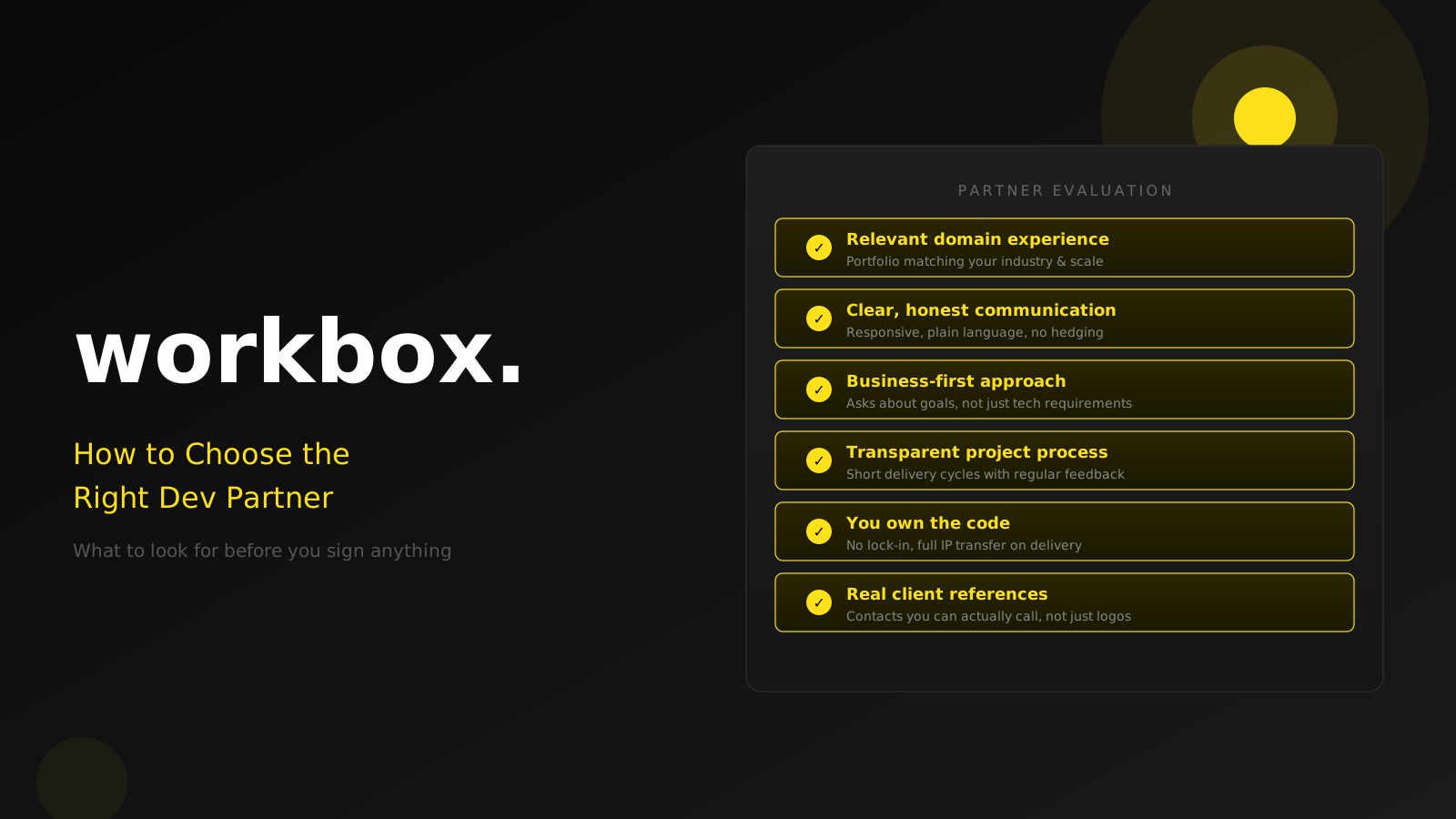
Every serious development company can show you a polished portfolio. The question is how relevant it is to your specific project.
Domain experience matters more than headline credentials. A team that has built field service management tools understands the specific challenges of mobile-first design, offline sync, and operational workflows in ways that a team with a more generalised portfolio may not. Domain experience means the team walks in with context — fewer surprises for both sides.
Project scale matters. A company experienced in delivering small-to-medium applications may not have the architecture and team-coordination experience needed for a complex, high-volume enterprise system. Ask about the largest and most demanding projects they have completed — and what made them hard.
Industry context matters. If you operate in a regulated sector — healthcare, finance, manufacturing — look for genuine experience navigating those compliance requirements. Teams that have dealt with GDPR, data retention rules, or sector-specific certifications before will not be learning on your time and budget.
Look past the pitch
The people you meet during the sales process are not always the people who will build your software. Before committing to any vendor, get clarity on the actual team.
Ask to meet the people who will work on your project. Not only the account manager or technical director — the developers, the project lead, the QA engineer. Your day-to-day experience depends on these individuals. If a company is reluctant to arrange this before signing, ask why.
Understand how the team is structured. Will you have a dedicated team, or will resources be shared across multiple client projects simultaneously? Who makes the day-to-day decisions on your project? Who is accountable when something goes wrong?
Ask about continuity. If a key developer leaves mid-project, what happens? Most professional agencies have documented procedures for this. The quality of the answer tells you something about how seriously they take their client relationships.
Test communication before you commit
You will communicate with your development partner constantly — in meetings, written updates, and regular reviews of work in progress. Communication style is not something you can negotiate once the contract is signed.
During the evaluation process itself, pay attention to:
Response speed and quality. If it takes several days to receive a clear answer to a simple question during the pitch, what does that tell you about the engagement to come?
Clarity over jargon. A partner who explains things plainly to a non-technical audience is a partner who will keep you genuinely informed throughout the project, not just in language you have to Google afterward.
Honesty over reassurance. If a potential partner tells you that everything is straightforward with no meaningful risks, they are not giving you the full picture. Reliable partners acknowledge uncertainty — and explain clearly how they manage it.
Ask about the process in detail
How a team works determines how reliably it delivers. Go beyond the generic answers and ask specifically:
How do you handle scope changes? Requirements evolve in almost every project. A good team has a clear, fair process for managing this — one that tracks changes, estimates their impact, and gets explicit approval before proceeding. A team without this process will either resist changes or absorb them in ways that create disputes later.
What does a typical development cycle look like? You should be seeing working software at regular intervals — not receiving status reports that describe things you cannot yet verify. Frequent, visible progress dramatically reduces the risk that months of work result in something you did not actually want.
How do you handle problems when they arise? Ask them to describe a specific situation on a past project where something went wrong. How did they recognise the problem? How did they communicate it to the client? How was it resolved? This answer tells you far more than any success story.
Understand what you will own
Intellectual property and code ownership should be clearly defined before any work begins. Make sure you understand:
- Who owns the code after delivery? You should own it outright, with no strings attached.
- Can you take the codebase to a different vendor in the future if you choose to?
- If open-source components are used, what are the licence terms?
- Are there dependencies on the vendor's proprietary tools or infrastructure that could create lock-in?
These questions may feel uncomfortable to raise, but they matter. The code being built is a business asset — treat it as one from the start.
Scrutinise the contract before signing
A well-structured contract protects both sides. Before signing, make sure it clearly covers:
- Scope of work — what is being built, described with enough specificity to be verifiable
- Acceptance criteria — how both parties agree that a deliverable is complete
- Payment milestones — tied to actual delivery, not just calendar dates
- Change management — how work outside the agreed scope is identified, priced, and approved
- Data security and ownership — who is responsible for what
- Post-launch support — what happens after go-live, and at what cost
Vague contracts almost always resolve in favour of the vendor when disputes arise. Take the time to push for specific language on every point that matters to you.
Red flags worth knowing
Some warning signs are easy to overlook when you are eager to get started:
A quote that seems unusually low. Underpriced proposals almost always carry underscoped requirements. The gap will surface later as scope disputes, quality shortcuts, or requests for additional budget at an inconvenient moment.
A partner who agrees with everything. Vendors who never push back on your assumptions have not seriously engaged with your problem. The best development partners ask difficult questions — not to be obstructive, but because clear thinking at the start prevents expensive mistakes later.
Vague answers about how they work. If you ask how they manage a project and receive generic descriptions, that vagueness will characterise the entire engagement. Process is observable — a good team can explain it precisely.
Pressure to decide quickly. Any vendor who implies that their availability will disappear if you do not sign this week is prioritising their own pipeline over your interests.
Reluctance to provide client references. Curated case studies show you what a company wants you to see. Conversations with actual former clients show you something closer to reality. There is no good reason for a reputable vendor to withhold references.
Questions worth asking before you decide
Bring these into your first substantive meeting:
- Walk me through a project that was difficult. What went wrong, how did you handle it, and what did the client experience?
- Who specifically will work on our project every day, and how available will they be?
- How do you communicate when something is behind schedule or not going as planned?
- What do you own after the project ends, and what do we own?
- Can we speak with two or three recent clients before deciding?
- What do you see as the biggest risk in a project like ours?
Good partners answer these questions directly and without defensiveness. Partners who deflect or become evasive in response to straightforward questions are showing you something important about how they will behave when things get hard.
The relationship is what you are really buying
At some point in every software project, something unexpected happens — a technical discovery that changes the approach, a business requirement that was not captured in the original scope, a delay that needs to be managed together. In those moments, what you have is not a contract. What you have is a relationship.
The best development partnerships are built on mutual trust: the client trusts that the team will be honest about problems and genuinely committed to solutions; the team trusts that the client will engage in good faith and make decisions promptly. Both sides invest in the relationship, not just the deliverable.
That is the standard worth holding any partner to — and worth holding yourself to as well.
Want to understand how we approach client relationships before you commit to anything? Get in touch. We think this conversation is a valuable part of the evaluation process — and we welcome every question on this list.