When companies decide it is time to digitalize, the conversation almost always starts with technology. Should we build an app? Should we buy a platform? Should we integrate AI?
But that is the wrong starting point. The most common mistake in digitalization is not choosing the wrong tool — it is automating the wrong process.
This article gives you a practical framework for identifying which parts of your business are genuinely ready for automation, which should wait, and how to prioritize when the list of candidates feels overwhelming.
Why "digitalize everything" is not a strategy
Every business runs on a combination of processes — some well-defined, some informal, some working, some broken. The instinct to "just digitalize everything" ignores an important reality: automating a broken process does not fix it. It makes it faster and harder to change.
Before any system gets built, the question to answer is: Is this process stable enough, and valuable enough, to be worth the investment of turning it into software?
Not all processes are. Some processes are genuinely better handled by people. Some are temporary and will change within a year. Some are broken at a level that automation cannot fix. Identifying the right candidates upfront is what separates a successful digitalization project from an expensive one.
The four questions that matter
For any process you are considering automating, work through these four questions. They will tell you quickly whether it belongs at the top of your list or in a holding pattern.
1. How often does this process repeat?
Automation pays back over time and volume. A process that happens once a year and involves two people is rarely worth automating. A process that happens fifty times a day and involves five people almost always is. The more frequently something runs, the faster the return on investment — and the faster you will notice when it is not working.
2. How much human time does it consume?
Not all processes are equal. Some feel painful but actually take very little time. Others feel routine but quietly consume significant hours across your team each week. Before any automation decision, it is worth measuring or estimating the actual time cost — including the time for errors, corrections, and the manual work that follows when something goes wrong.
A useful calculation: multiply the time per instance by the number of instances per month, then multiply by the number of people involved. Even rough estimates often reveal where the real time is going.
3. How rule-based is it?
Automation excels at processes that follow clear, consistent rules. If the logic is: when X happens, do Y, unless Z, in which case do W — that process is a strong automation candidate. If it relies heavily on contextual judgement, relationship management, or domain expertise that cannot be written down, automation will struggle.
A practical test: could you train a new employee to follow this process using a written procedure? If yes, it can probably be automated. If the answer is "it depends on the situation," that is a signal the process is not ready.
4. What is the cost of getting it wrong?
Some processes can tolerate errors gracefully — a mistake is caught, corrected, and life goes on. Others have significant consequences: regulatory exposure, customer impact, financial loss, or reputational damage. High-stakes processes can absolutely be automated, but they require more careful design and testing. They are not where you start.
Low-stakes, high-volume, rule-based processes that consume significant time are almost always the right first candidates.
Processes that seem like good candidates but are not
Experience with digitalization projects reveals a consistent pattern: certain processes attract a lot of enthusiasm for automation but consistently underdeliver.
Processes that are broken at a fundamental level. If your process involves people constantly making exceptions, working around the official procedure, or maintaining shadow spreadsheets because the "official" system does not reflect reality — the problem is not a lack of software. The problem is the process itself. Building software on top of a broken workflow bakes the confusion in permanently.
Processes that are changing soon. Automating something that is about to be restructured wastes both the investment and the transition effort. If a process is tied to a product, team structure, or regulatory framework that is in flux, it is better to wait until the change has settled.
Processes owned by only one person. If a process runs on the specific knowledge and habits of one individual — and that person is not willing to document it and change how they work — it is very hard to automate successfully. Automation requires process clarity that lives outside any individual's head.
One-off or seasonal processes with low frequency. Building software for a process that runs twice a year may not pay back within any reasonable timeframe. Sometimes the better answer is a well-designed template, a checklist, and a clear handover protocol.
How to prioritize when you have many candidates
Most businesses that think seriously about this exercise end up with more automation candidates than they expected. The challenge becomes prioritization.
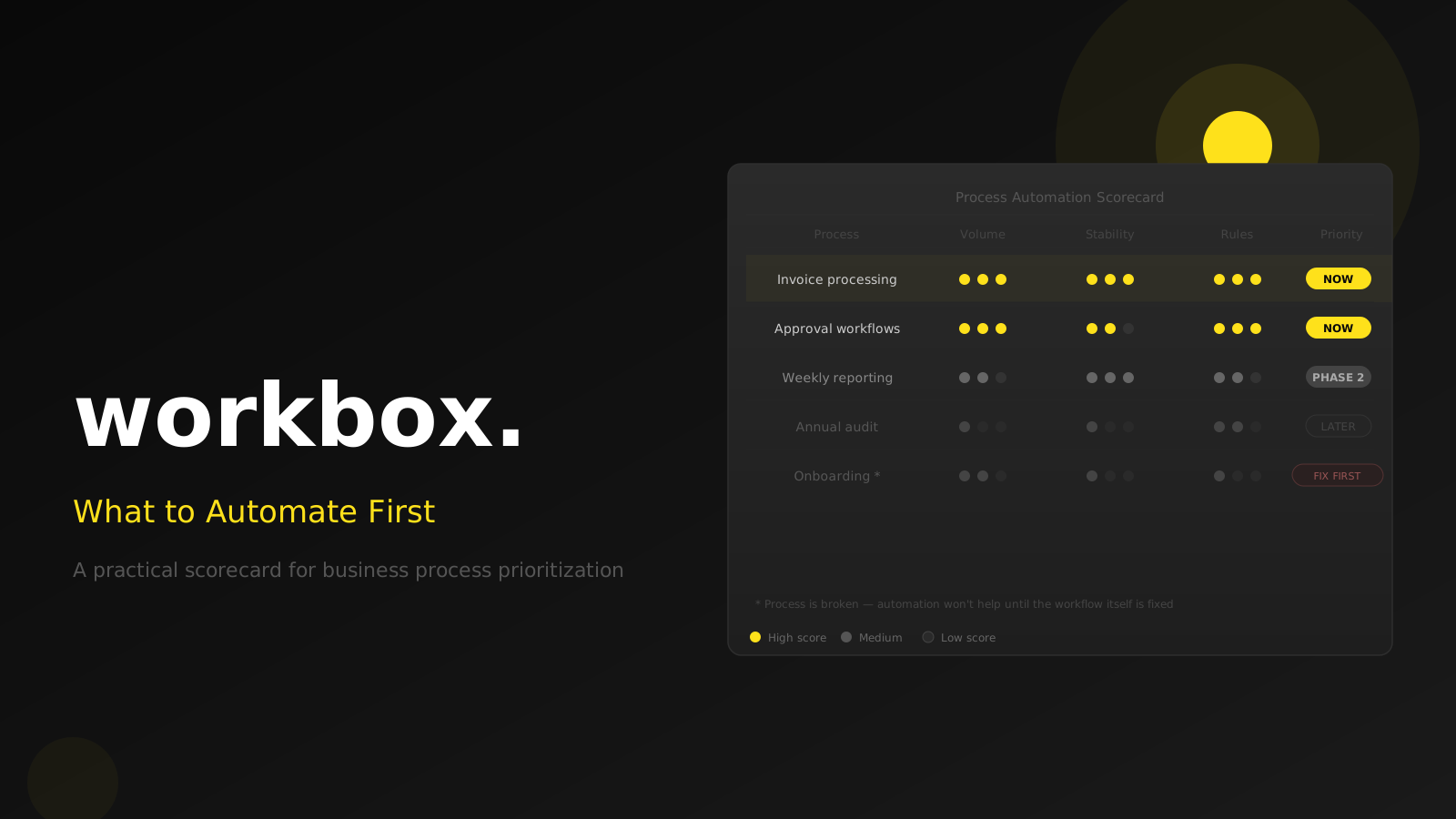
A straightforward approach is to score each candidate on three dimensions:
- Volume × time: How much human effort does this process consume per month?
- Stability: How likely is this process to remain essentially unchanged for the next two to three years?
- Complexity: How rule-based and definable is this process, versus how much does it rely on judgment?
Processes that score high on all three dimensions are your first priorities. Processes that score high on volume but low on stability are candidates for a second phase, once the process has settled. Processes that are stable and rule-based but low-volume belong at the bottom of the list.
A simple scoring matrix on a single page is often enough to facilitate the conversation with your team — and to build alignment before any commitment to build.
Where most businesses actually start
When we work through this exercise with clients, the first automation candidate is almost never the one they originally came in asking about.
Commonly, businesses arrive thinking they need a customer-facing application. After mapping their processes, they discover that the biggest time sink and the clearest opportunity is something entirely internal: a production planning workflow, an approval chain, an invoicing process, or a manual reporting routine that takes a full day each week.
Internal processes rarely get the attention that customer-facing ones do. But they often deliver the fastest and clearest return. They are used by people who are motivated to make the tool work, the complexity is bounded, and the success of the automation is directly measurable in hours saved.
If you are not sure where to start: look at what your team does repeatedly, manually, in spreadsheets or by email, that could be replaced with a structured system. That is usually where the real opportunity is.
A few things to expect from the process
Identifying automation candidates is not a one-time exercise. As your business changes, the right processes to automate will shift. Ideally, you revisit the question periodically — perhaps once a year — rather than treating it as a one-off analysis.
Also expect some resistance. People who have developed workarounds and habits around a particular manual process are often — understandably — protective of them. Building a shared understanding of why a process is being automated, and involving the people who use it in the design, makes a significant difference to how well it gets adopted.
And expect that the first automation you build will teach you things you did not know before you built it. The best digitalization projects treat the first phase as a learning exercise as much as a delivery exercise. What you discover from using real software in practice will shape the second and third phases more than any amount of upfront planning.
The right question to start with
The most useful question you can ask at the beginning of a digitalization effort is not "what technology should we use?" It is "which of our manual processes costs us the most time, carries the most risk, and is stable and rule-based enough to automate reliably?"
Answer that question first. The technology follows naturally.
Trying to work out where to start with your own business processes? Get in touch — we will help you map your processes, identify the right candidates, and build a realistic plan that delivers results in the near term.