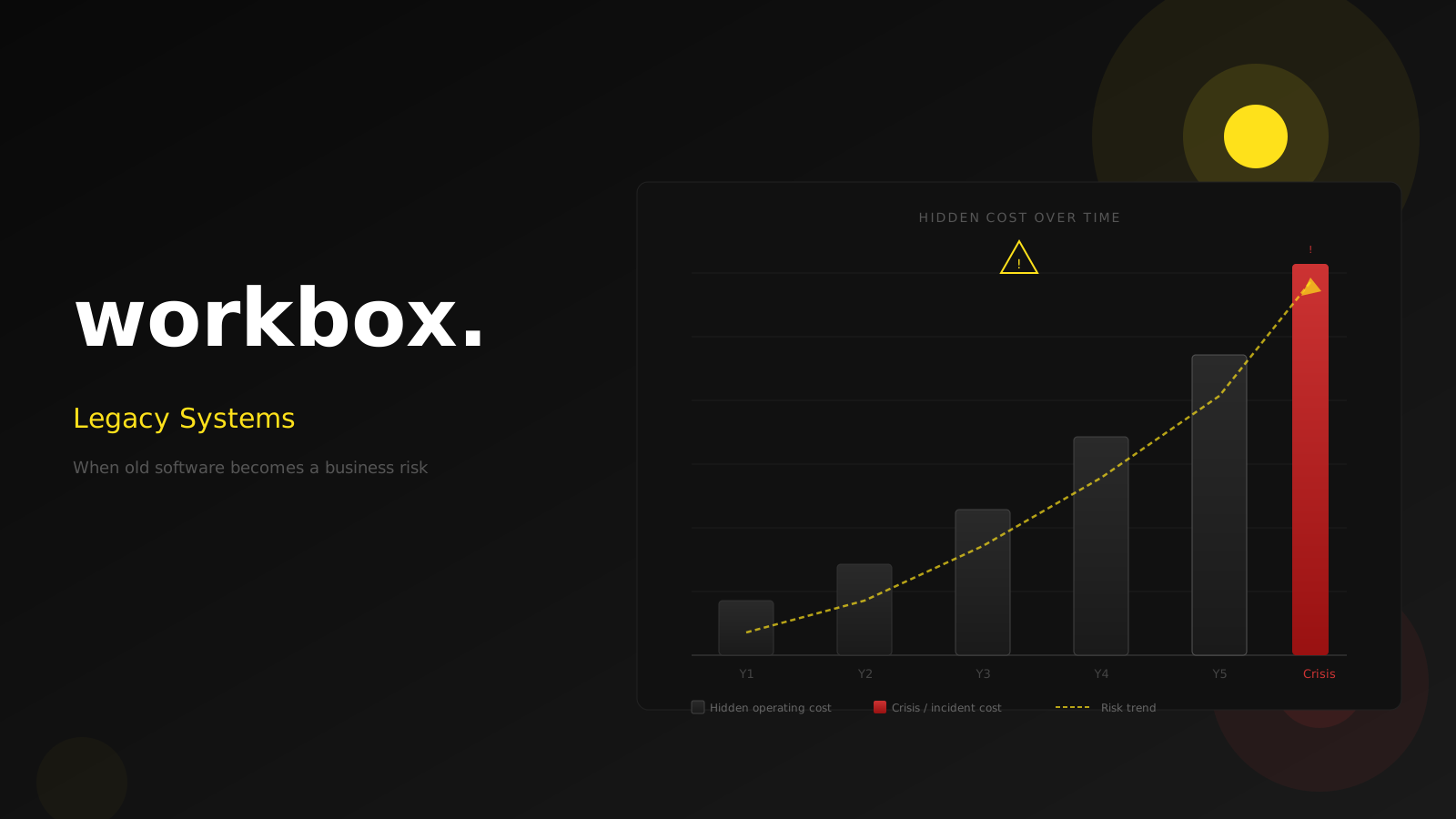
There is a piece of software in almost every established business that nobody wants to talk about. It runs in the background. Everyone knows how to work around its quirks. And whenever someone suggests replacing it, the conversation quietly dies — because the last time it came up, the project felt too big, too risky, or too expensive.
This is a legacy system. And the longer you wait to address it, the more it costs you.
What counts as a legacy system?
A legacy system does not have to be ancient. It is any software that has become a constraint on how your business operates — software you are stuck with rather than choosing.
The most common signs:
- Nobody knows exactly how it works anymore. The person who built it or understood it deeply has left. What remains is a working black box.
- It cannot easily connect to other tools. Your new CRM, your accounting software, your warehouse system — they all have to work around the legacy system rather than with it.
- Changes are slow and risky. Even small modifications take a long time, and every change feels like it might break something unpredictable.
- It runs on infrastructure that is going out of support. An older database engine, a server operating system that no longer receives security patches, a framework that has not been maintained for years.
- People have built workarounds. Spreadsheets, email threads, manual re-entry of data from one screen to another — all compensating for things the system does not do well.
If any of this sounds familiar, you are carrying costs that do not appear on any invoice.
The costs that hide in plain sight
The most dangerous costs of a legacy system are the ones you do not measure because they feel normal.
Staff time spent on manual workarounds adds up fast. If three people each spend an hour a day manually moving data between systems, that is over 700 hours a year — before you account for mistakes. At an average fully-loaded cost of €40 per hour, that is €28,000 annually on tasks that should not exist.
Errors and rework are a hidden tax on your operations. When data has to be entered in two places, it will eventually be entered differently in both. When reports are assembled manually, they will occasionally be wrong. The direct cost of catching and correcting errors is significant. The indirect cost — decisions made on incorrect information — is harder to measure but often larger.
Onboarding new staff takes longer when systems are unintuitive and undocumented. New employees cannot look up how things work; they have to learn from colleagues who are already busy. This friction is invisible in the P&L, but it slows growth and strains teams.
Missed opportunities are the hardest cost to quantify, and often the most significant. When a new channel, a new product, or a new way of working would require significant changes to the legacy system, it often simply does not happen. The business adapts to its software instead of the other way around.
Security exposure is the cost that can turn into a crisis. Legacy systems that run outdated software stacks are known targets. A single successful attack can cost a business far more than any upgrade ever would.
Why businesses keep living with it
If the costs are so clear, why do so many businesses carry legacy systems for years or decades?
Familiarity creates comfort. People know the system. They have adapted to it. The idea of disruption feels worse than the current friction.
The risk feels asymmetric. The costs of staying are spread out and invisible. The costs of a bad migration feel concentrated and catastrophic. This perception is usually wrong — but it feels real.
Nobody owns the decision. Migrating a core system touches many departments, and nobody wants to be the one who disrupted everyone else's work. The project ends up in perpetual committee.
Previous failed attempts loom large. Many businesses have a story of a previous software project that went over budget, missed the deadline, or delivered something that nobody used. That experience makes the next attempt feel riskier than it really needs to be — especially if the right lessons were not drawn from what went wrong.
How to know when the cost of staying has become too high
There is no single threshold. But there are signals that suggest the balance has shifted:
- The workarounds are more elaborate than the processes they are working around
- A key person leaving would create a genuine operational crisis
- You have turned down a business opportunity because the system could not support it
- A security audit has flagged the system as a liability
- The annual maintenance cost of keeping the old system running is approaching what a replacement would cost to build
When multiple signals appear together, waiting is no longer the conservative choice. It is the risky one.
What a sensible path forward looks like
The good news is that replacing a legacy system does not have to be a single enormous leap. Done well, it is a structured process that manages risk at every step.
Start with a clear picture of what the system actually does. Many businesses are surprised to discover that their legacy system does fewer things than they thought — the rest is workarounds. Understanding the real scope makes the replacement project much more manageable.
Prioritise the highest-pain areas. You do not need to replace everything at once. Often, addressing the two or three biggest bottlenecks delivers most of the value. The remaining functionality can be migrated in phases.
Plan for data migration early. Data is typically the most complex part of any legacy migration. Understanding what data you have, what quality it is in, and how it will move to a new system needs to happen before development begins.
Keep the old system running in parallel while the new one matures. A well-managed cutover is not a cliff edge. There is a period where both systems run, the new one is validated against real use, and the team builds confidence before the old one is switched off.
Pick a partner who understands this kind of project. Legacy migrations require a different mindset than greenfield development. The ability to understand an existing system, extract knowledge from it, and migrate it cleanly is a specific skill — not all development companies have it.
The question to ask yourself
Here is a simple way to frame the decision: If you were starting your business today, would you choose this system?
If the answer is no — and it usually is — then the question is not whether to change, but when. And the longer the answer to "when" is "not yet," the more you pay for the gap between the system you have and the system you need.
If you are trying to understand what your legacy system is actually costing you — or whether it is time to start planning a replacement — talk to us. We have helped businesses navigate migrations of all sizes, and we are happy to give you an honest picture of what it would involve.