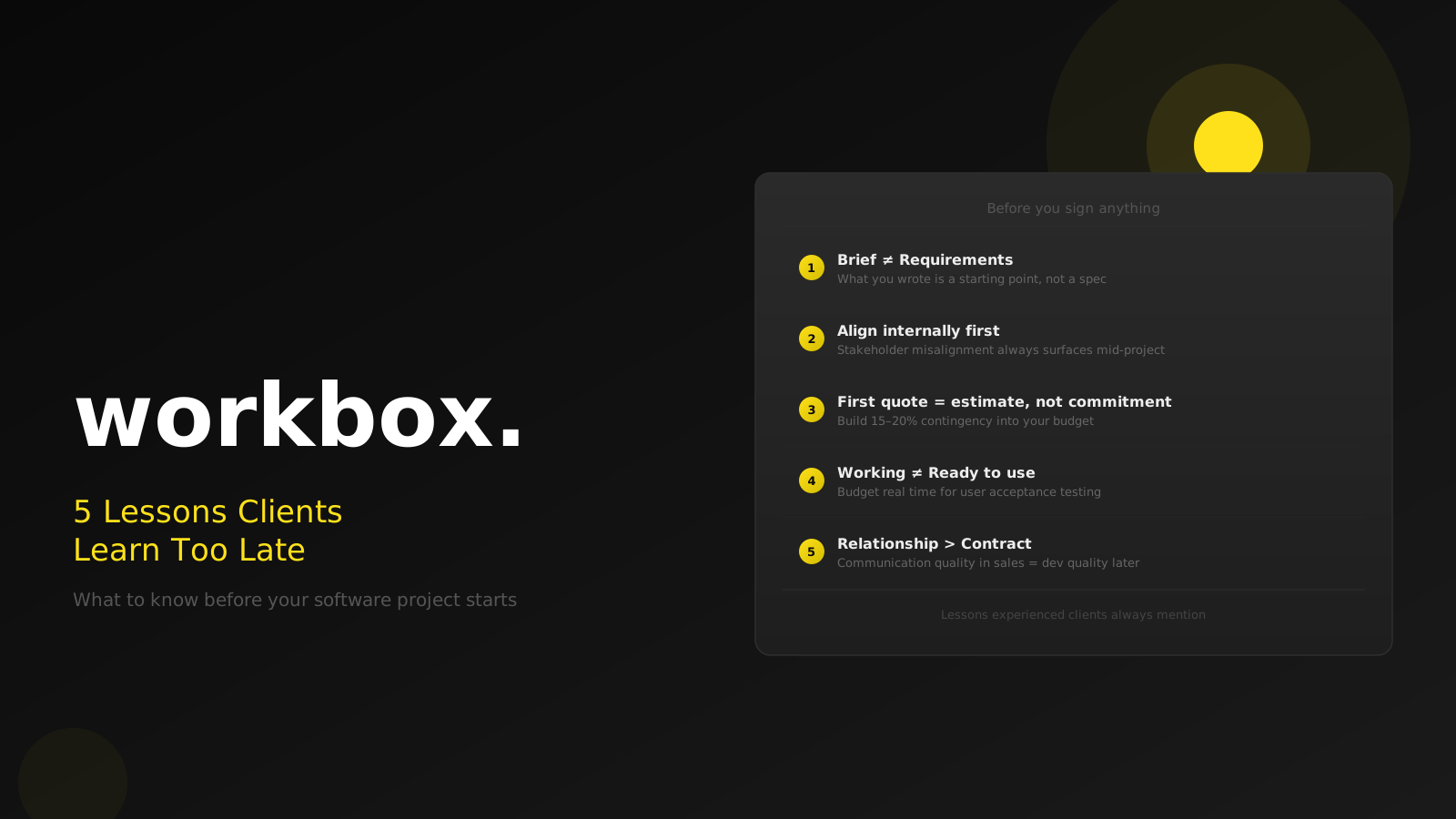
After you have commissioned software once, you know things you did not know before. Not because the project failed — sometimes it was a success — but because the experience teaches you things that no briefing document or sales conversation covers.
We have talked to many business owners who have been through at least one software project. When we ask what they would do differently, the same five lessons come up again and again. None of them are complicated. But they are easy to miss when you are doing it for the first time.
1. Your brief is not your requirements
Most clients arrive at the first meeting with a well-thought-out description of what they want. It is usually a document, a presentation, or a detailed email outlining the desired features, the expected users, and the rough budget.
This is a good starting point. But it is not the same as a set of requirements.
The difference becomes clear once development begins. A brief describes an idea from the outside — what you want the software to do. Requirements describe how the software actually needs to work, step by step, for every type of user, in every scenario that can occur.
The gap between the two is where most project problems live.
A business owner might write: "Users should be able to submit orders." A developer building from that sentence will ask: What type of users? What products can be ordered, and in what combinations? What happens when an item is out of stock? What confirmation does the user receive? Can orders be cancelled, and if so, by whom and until when? What happens if the payment fails?
Each of these questions has an answer that shapes how the software is built. When those answers are discovered during development — rather than before — they create delays, rework, and sometimes fundamental redesigns.
What experienced clients do differently: They allow time for a structured requirements phase before any code is written. They bring the people who will actually use the system into the conversation early. They treat the effort of defining requirements not as an obstacle to starting — but as the project itself beginning.
2. Internal alignment matters more than you expect
Commissioning software is often a decision made by one person: the owner, the CEO, or the head of a department. But the software itself will be used by a much wider group of people — and those people often have very different ideas about what they need.
This gap between the decision-maker and the end user is one of the most consistent sources of project friction. It usually surfaces about halfway through development, when internal stakeholders see the first version and realise it does not quite match what they had in mind.
Sometimes the mismatch is small and easy to fix. Sometimes it is large enough to require significant rework. Either way, it costs time and money that would not have been needed if the right people had been in the room earlier.
This is not a criticism of clients. Most businesses are busy, internal processes are complex, and getting everyone aligned takes effort. But the cost of that effort is almost always lower than the cost of fixing misalignment during development.
What experienced clients do differently: They identify the key internal stakeholders — department heads, team leads, power users — before the project starts, and involve them in the requirements process. They run internal workshops, gather conflicting opinions, and resolve them before presenting a unified brief to the development team. They build internal alignment as explicitly as they would build any other part of the project plan.
3. The first quote is rarely the final number — and that is not a sign of dishonesty
One of the most unsettling moments in a software project is when the price starts to shift from what was originally quoted. This can feel like a bait-and-switch — and in rare cases of bad actors, it is. But much more often, it reflects something simpler: the project was not fully defined when the first estimate was given.
Software quotes are estimates, not fixed prices — unless the scope is fixed, the requirements are detailed, and the unknowns have been resolved. When a company gives you a quote based on a brief rather than a detailed specification, they are estimating based on assumptions. As those assumptions are tested against reality during planning and development, the number adjusts.
This is not dishonesty. It is how estimation works for complex, bespoke work. A construction company cannot give you a fixed price for a building without seeing the ground survey, the architectural drawings, and the materials specification. A software company faces the same challenge.
The clients who feel most burned by budget surprises are usually those who treated an early estimate as a commitment before the requirements were solid.
What experienced clients do differently: They ask for estimates at different stages — a rough range at the brief stage, a more detailed figure after discovery, and a fixed price (if that is what they want) only once requirements are thoroughly defined. They build contingency into their budget — typically 15 to 20 percent — to cover the changes that almost always arise. They ask the development team specifically what assumptions underlie the estimate.
4. "Working" and "ready to use" are two different things
There is a phase in almost every software project where the development team announces that the feature is built. And then comes the moment of using it for the first time and discovering that — while it technically works — something about it is not quite right.
The button is in the wrong place. The workflow does not match how the team actually works. The labels use technical terms that nobody in the office understands. The most important function requires three extra clicks that slow everything down.
None of this means the software is broken. It means software needs testing and feedback before it is truly ready — and that testing must be done by real users doing real tasks, not just by developers checking that the code runs.
This phase is called user acceptance testing, and it is where a significant amount of the practical value of the project gets shaped. It is also where many first-time clients underinvest. They see it as a formality — a checkbox before launch — rather than as an essential part of building something that people will actually use well.
What experienced clients do differently: They plan time and capacity for proper user testing before go-live. They involve actual users — not just managers — in reviewing each feature. They treat feedback from testing as expected and valuable, not as evidence that something went wrong. They give the development team structured, specific feedback rather than general impressions.
5. The relationship with your development partner matters more than the contract
Before a project starts, the contract feels important. It defines who is responsible for what, what happens if something goes wrong, and how disputes are handled. These things matter, and a good contract is worth having.
But over the course of a real project, the contract rarely comes up. What comes up constantly — in every meeting, every email, every decision — is the quality of the relationship between the client and the development team.
A good development partner will tell you when something you have asked for is not the best approach. They will flag when scope is expanding before it becomes a problem. They will explain technical constraints in plain language rather than hiding behind jargon. They will treat your business goals as the measure of success, not just the task list.
A difficult relationship — even with technically competent developers — produces projects where problems fester, where questions go unanswered, where feedback is not heard, and where both sides end up dissatisfied despite everyone technically doing their job.
Experienced clients pay as much attention to the quality of communication in the sales process as they do to the technical credentials and the price. Because the conversations during a proposal tell you a great deal about what the conversations during development will be like.
What experienced clients do differently: They pay attention to how responsive, honest, and clear the development company is before signing anything. They look for partners who ask probing questions, challenge assumptions, and explain their reasoning — not just those who agree with everything and promise fast delivery. They invest in the relationship itself: regular communication, timely feedback, and treating the development team as collaborators rather than contractors.
None of these lessons require unusual insight to understand. They are common sense once you have seen them play out. The challenge is that they are easy to undervalue before the project starts — when everything still feels full of possibility and it seems premature to be worrying about what could go wrong.
That is precisely when it matters most to think about them.
If you are planning a software project and want to think through any of these points before you begin, talk to us. These conversations are always easier before the contract is signed.