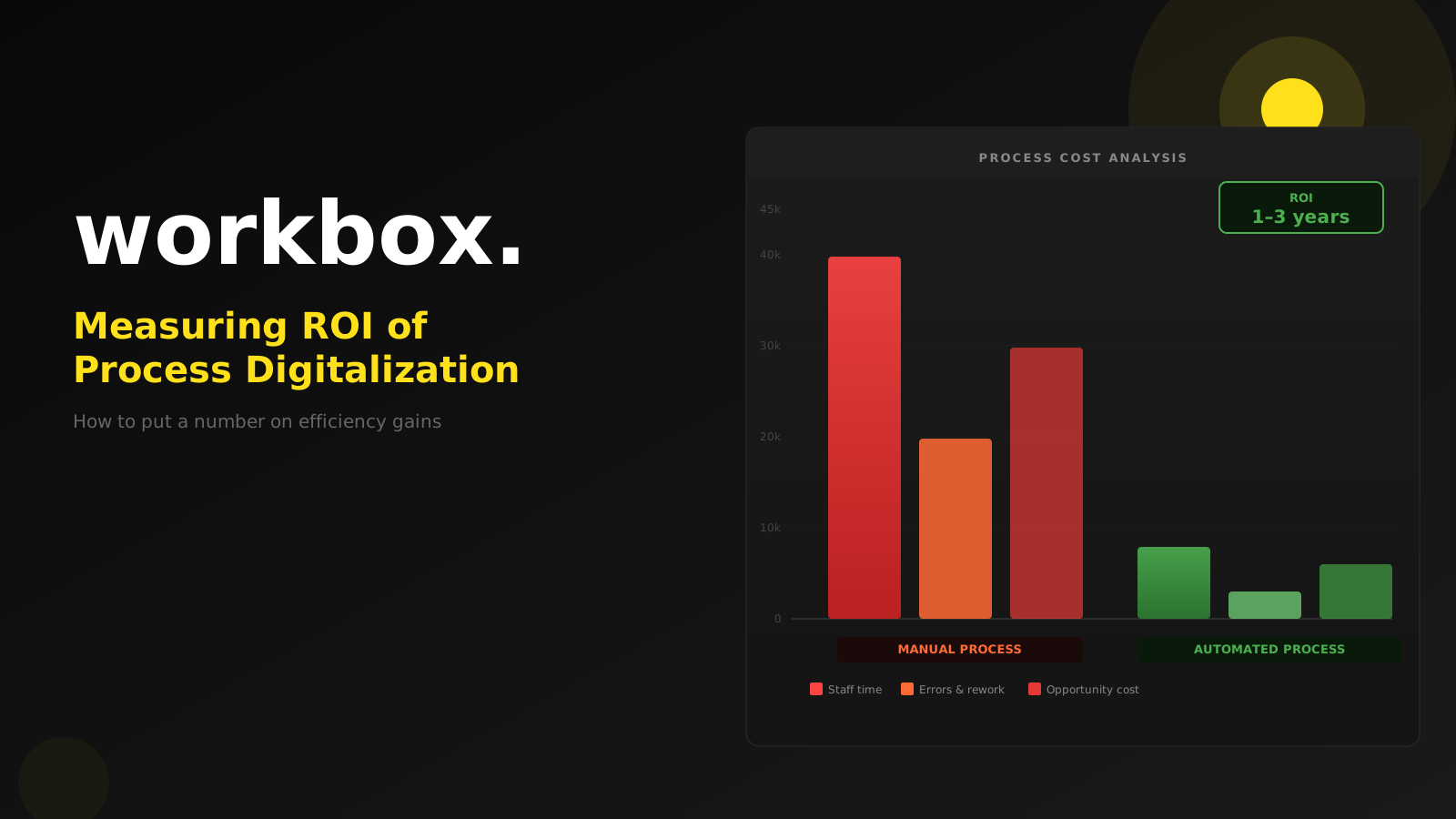
The decision to digitalize a business process often starts with a gut feeling: this is inefficient, it should be automated. That feeling is usually right.
But turning a gut feeling into a budgeted project — one that gets sign-off, that can be evaluated against alternatives, and that you can genuinely claim was worth doing — requires something more concrete: a way to put numbers on the value.
This is where many businesses stall. Measuring efficiency feels abstract. The benefits seem real but hard to quantify. So the project stays on the "things we should do" list.
This article gives you a practical framework for measuring the return on digitalization investments — one that works whether you are evaluating a single process automation or a broader initiative.
Start with time: the most visible cost
The most straightforward benefit to quantify is time saved. For most process automations, this is also the most significant.
Begin by mapping the current state. For the process you are considering automating:
- How many times does this process run per week or per month?
- How many people are involved each time it runs?
- How long does each step take?
- What is the fully-loaded hourly cost of the staff involved?
Then run the calculation:
Annual time cost = frequency × minutes per occurrence × hourly staff cost × 52
For example: an order confirmation process that runs 200 times per week, takes 8 minutes each time, and involves a staff member at an effective cost of €35/hour.
200 occurrences × 8 minutes = 1,600 minutes per week = 26.7 hours 26.7 hours × €35 = €933 per week €933 × 52 weeks = €48,516 per year
Automation that eliminates 80% of that manual work recovers roughly €38,800 annually. If the automation costs €25,000 to build and €5,000 per year to maintain, it pays for itself in under a year and delivers net savings from Year 2 onwards.
This is a simple model. Real projects involve more variables. But the principle is the same: the time cost of a manual process is almost always larger than it first appears.
Account for error rates and their consequences
Manual processes carry error rates that automated ones largely eliminate. A missed email, a data entry mistake, a misrouted approval — these errors have costs that are often invisible but very real.
The costs of process errors tend to fall into three categories:
Direct rework. When a mistake is caught, someone has to fix it. That fix takes time — often more time than the original task. And it may involve multiple people: the person who made the error, their manager, the client or supplier affected.
Delayed decisions. An error in a report or a missing piece of data can delay a decision that has downstream consequences. The cost of that delay is hard to measure precisely, but it is rarely zero.
Customer impact. Errors that reach customers — wrong orders, incorrect invoices, missed follow-ups — carry a reputational cost beyond the direct fix time. Customer trust is hard to quantify but easy to lose.
When building your ROI case, estimate the current error rate and the cost of a typical error. Even a rough estimate — "we catch three or four mistakes per week, each costing roughly two hours to fix" — gives you a number to include in the model.
Include the cost of not automating
ROI calculations usually focus on what automation delivers. Just as important is what manual processes cost over time — including costs that tend to grow.
Scaling costs. A manual process that works at current volumes will typically require proportionally more staff as the business grows. An automated one scales without adding headcount. The difference becomes significant quickly.
Retention and morale. Repetitive, manual data entry and administrative work is not the most engaging part of any job. Staff who spend significant time on it tend to be less satisfied and more likely to leave. Replacing an experienced team member typically costs between 50% and 200% of their annual salary. Automation that removes the drudgework can measurably improve retention.
Opportunity cost. The most underappreciated ROI is the work your team is not doing because they are occupied with manual processes. If a staff member spends 10 hours per week on tasks that could be automated, that is 10 hours of capacity that could be directed at higher-value work. Quantifying this is harder, but it is often the most significant benefit.
How to structure the business case
A practical ROI analysis for a digitalization project has three parts:
1. Costs
- Development or implementation cost (one-time)
- Annual maintenance and support cost
- Training and change management time
2. Quantifiable benefits (per year)
- Time saved × staff cost per hour
- Error reduction × cost per error
- Infrastructure or tool costs eliminated by replacing manual workarounds
3. Strategic benefits (qualitative, but worth naming)
- Scalability without headcount growth
- Improved staff experience and retention
- Better data quality and visibility for management decisions
- Compliance, audit trail, and reporting improvements
A well-structured business case presents all three parts. Decision-makers who see only the cost and quantifiable return often undervalue strategic benefits — naming them explicitly closes that gap.
What a realistic payback timeline looks like
For most mid-sized process automations — projects in the €15,000–€60,000 investment range — payback periods of one to three years are typical when the process is well-chosen and the automation is well-built.
Shorter payback times are common for:
- High-frequency processes (hundreds of occurrences per week)
- Processes involving multiple staff members with significant hourly costs
- Processes with notable error rates or substantial rework costs
Longer payback times are more common for:
- Low-frequency or low-staff-cost processes
- Projects with significant integration complexity
- Automations that require substantial change management effort
A quick filter before you build the full case
Before investing time in a detailed ROI calculation, a quick test helps:
- Does this process run at least weekly?
- Does it involve more than one person or more than thirty minutes of work each time it runs?
- Is it rules-based enough that software could handle it reliably?
If the answer is yes to all three, a more detailed analysis is likely worthwhile. If you are not sure, a short conversation with a development partner can help you assess whether automation is technically feasible and what it would realistically cost to build.
The time cost of that conversation is small. The cost of running an expensive manual process for another three years is not.
If you have a process in mind and want help putting a number on what automating it might be worth, get in touch. We will walk through the numbers honestly — including when automation is not the right call.