Off-the-shelf software is a brilliant starting point. It is affordable, fast to deploy, and built on the experience of thousands of businesses that came before you. For most companies in their early years, it is the right choice.
But businesses grow. Processes mature. Teams expand. And what was a sensible, cost-effective decision three years ago can quietly become the thing that is holding you back — without anyone noticing until the friction has become genuinely expensive.
The problem is that the transition is gradual. There is rarely a single moment when your accounting software, CRM, or operations platform stops working. Instead, there is a slow accumulation of workarounds, manual steps, and limitations that your team absorbs so gradually that it starts to feel normal.
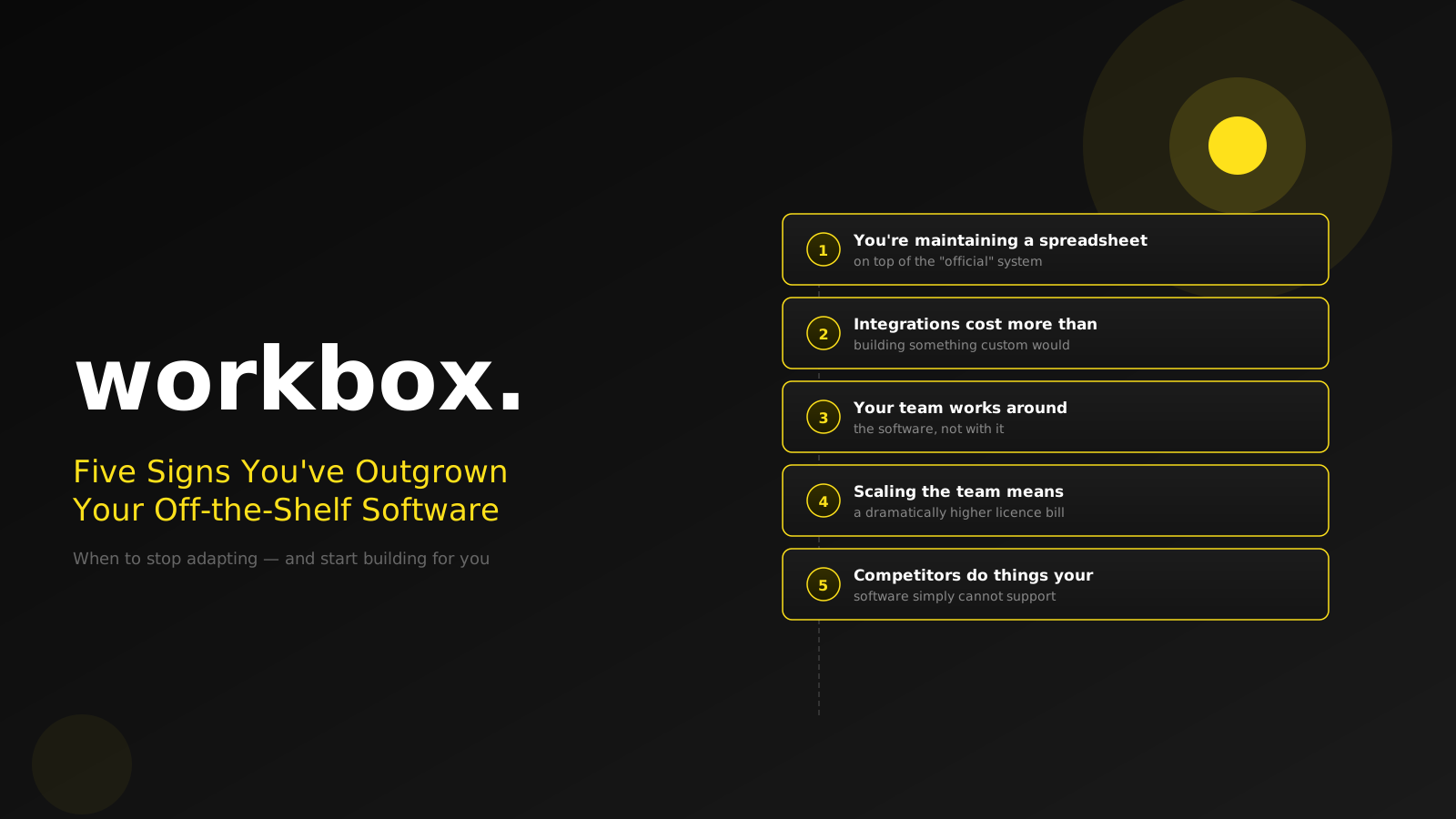
Here are five patterns worth paying attention to.
Sign 1: You are maintaining a second system alongside the official one
When a team runs a spreadsheet, a shared inbox, or a side database "in addition to" the main software, that is not a sign of poor discipline. It is a sign that the main software does not support something the team genuinely needs.
Look around your business. If you find people tracking things in spreadsheets that "should" be in the system, or maintaining their own local records because the official tool is too slow or too inflexible to capture what they need, you have found a gap between what the software does and what your business actually requires.
These workarounds are particularly expensive because they are invisible to management. The extra time people spend on them never shows up on a report. The errors that creep in when data exists in two places are hard to trace back to the root cause. Over time, the unofficial system grows more elaborate — and more fragile.
Sign 2: Integrating your tools costs more than building something new
Modern businesses run on a stack of specialised tools: a CRM, an ERP or accounting platform, an e-commerce system, a logistics provider, a support desk. Each of these is useful on its own. The value multiplies when they share data.
The problem with off-the-shelf tools is that integration is often an afterthought — and an expensive one. You pay for third-party connectors, middleware platforms, or dedicated IT time to keep data synchronised between systems that were never designed to work together. Every API version update from one vendor can break a connection. Every new tool you add increases the complexity.
At a certain point, the cost and fragility of stitching together off-the-shelf systems exceeds the cost of building something that treats your whole workflow as a single, coherent problem. That is a significant threshold — but it is one that growing businesses reach more often than they expect.
Sign 3: Your team works around the software rather than with it
This one is subtle, but important. When people use a system heavily and know it well, they develop workarounds — clever ways to achieve things the software was not quite designed for. They export to Excel because the reporting module is not flexible enough. They use calendar events because the task system cannot handle a particular kind of workflow. They keep notes in a shared document because the field in the system is too short or too rigid.
These workarounds are evidence of unmet need. Each one represents a place where your business process and your software's design do not quite line up.
Individually, they are irritants. Collectively, they represent a significant drain on productivity, and a growing source of risk. When key processes depend on informal workarounds, they depend on specific individuals knowing the trick — and they break when those individuals leave.
Sign 4: Scaling your team means a dramatically higher licensing bill
Per-seat pricing is simple and fair at small scale. But the economics change significantly as your business grows.
If adding ten people to your team means adding ten expensive licences for every tool in your stack, software costs can become a material factor in headcount decisions. Some businesses find themselves in the position of delaying hiring because the per-seat cost of their existing tools makes growth disproportionately expensive.
Custom software typically involves a different cost structure: a higher upfront investment, but no per-seat fees, no feature tiers, and no vendor deciding what functionality is available at what price point. For businesses beyond a certain size, this structure often makes custom software meaningfully cheaper over a five-year horizon — even accounting for development, maintenance, and ongoing evolution.
Sign 5: Your competitors are doing things your software simply cannot support
This is perhaps the most strategic indicator. Off-the-shelf software is designed to serve the widest possible market. That means it is optimised for common cases, not for differentiation.
If you find yourself thinking "we could offer our customers X, but our system does not support it" — or watching a competitor do something that you cannot replicate because of a platform constraint — that is a meaningful signal. Software that caps what your business can do is not neutral. It is actively limiting your competitive position.
The most valuable custom software investments tend to be the ones that unlock something specific: a process your competitors cannot easily copy, a customer experience your industry has not seen, an operational efficiency that compounds over time. These are not things that off-the-shelf vendors build into their roadmaps — because they would only benefit you.
What to do when you recognise these patterns
Recognising the signs is the first step. The second is understanding what to do next.
The answer is not always "build everything from scratch." For many businesses, the right move is a hybrid: keep the tools that work, identify the specific gaps, and build custom software to fill exactly those gaps — connecting to your existing systems rather than replacing them wholesale.
This is often faster, cheaper, and less disruptive than a full migration, and it gives you the flexibility to start with the highest-value problem rather than trying to solve everything at once.
The right conversation to have is with a development partner who is willing to tell you when custom software is not the answer — as well as when it is. That candour is usually a good sign.
If any of these patterns sound familiar and you would like a second opinion on where custom software would actually help your business, get in touch. We will tell you honestly what makes sense — and what does not.