You have agreed in principle that a custom software project makes sense for your business. You have had an initial conversation with a development company, and things look promising. Then you hear the words: "We'll need to start with a discovery phase."
For many business owners, this is where the confusion begins. What does that mean? How long will it take? Why can't they just start building?
This article explains what the discovery phase looks like from your side of the table — what actually happens, what you will need to do, and what you should have at the end.
What the discovery phase actually is
The discovery phase — sometimes called requirements gathering, analysis, or scoping — is the structured process of figuring out exactly what needs to be built before anyone writes a line of code.
It is a working phase, not an administrative one. Real conversations happen. Real decisions get made. And the output is not just a document — it is shared understanding between your team and the development team about what the system needs to do, why it needs to do it, and how it should work.
Done well, discovery eliminates the most expensive kind of software problem: building the wrong thing. The cost of changing direction during development is measured in weeks and budget. The cost of changing direction during discovery is measured in hours.
What happens during discovery
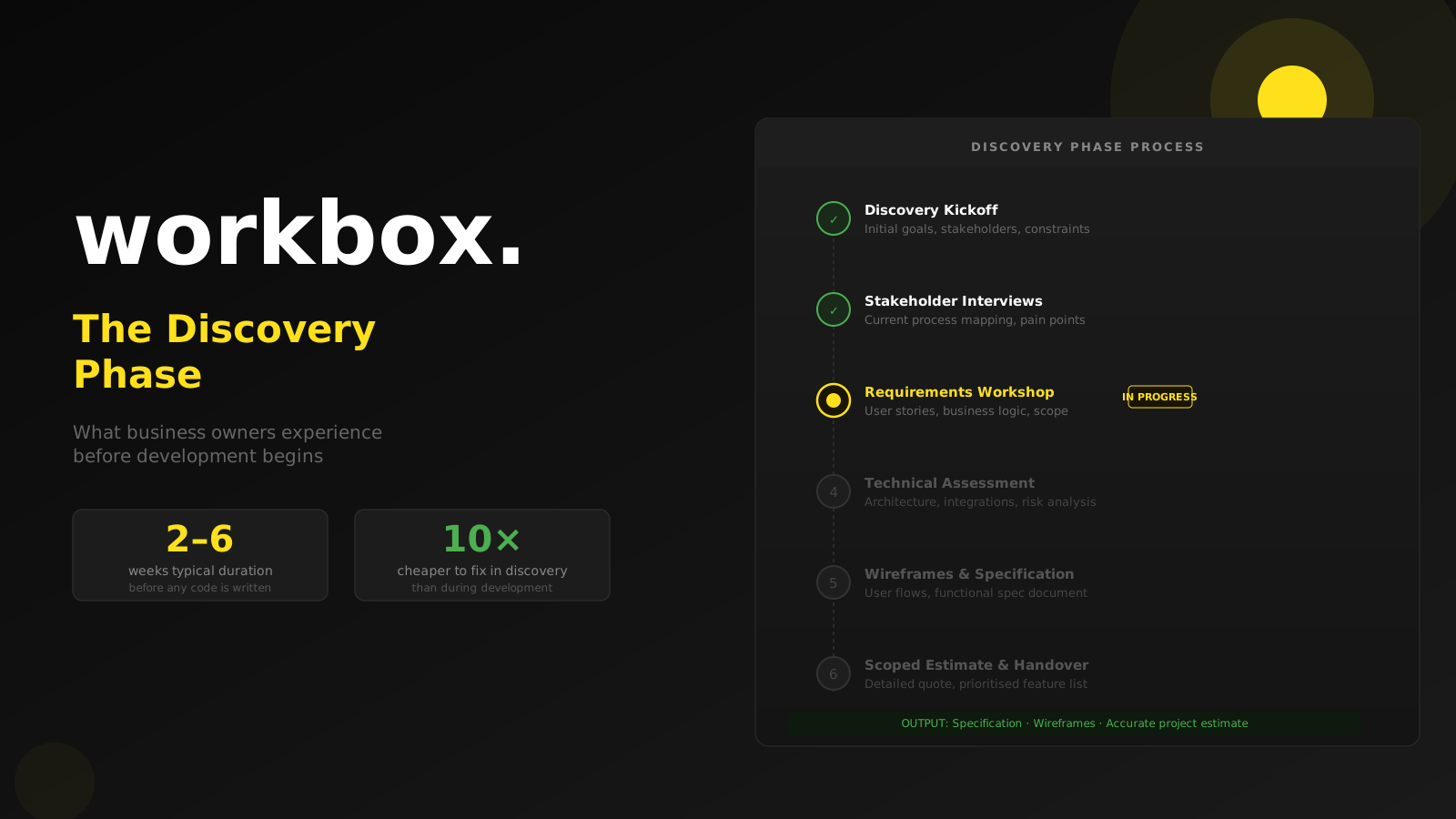
Discovery typically runs between two and six weeks for most business software projects, though complex or large-scale systems can take longer. Here is what that time actually involves.
Structured interviews and workshops
The discovery process is conversation-heavy. You will meet with the development team — usually a business analyst, a solution architect, and sometimes a UX designer — and work through a structured set of questions.
These conversations cover a lot of ground: what your current processes look like, where the pain points are, who uses the system and how, what the exceptions and edge cases are, what success looks like, and what constraints you are working within (budget, timelines, regulatory requirements, existing systems).
Do not be surprised if the questions feel broader than you expected. A good analyst will probe beyond the surface-level request to understand the underlying business problem. The solution you described in your brief may be exactly right — or there may be a better approach that only becomes visible when the full picture is understood.
Mapping your current state
Before designing a new system, the team needs to understand the system — formal or informal — that it will replace. This means documenting how your processes actually work today, not how they are supposed to work on paper.
This is where business owners sometimes encounter a surprise: the gap between documented process and actual practice is almost always larger than expected. People have developed workarounds, informal tools (usually spreadsheets), and tribal knowledge that never made it into any manual. Discovery surfaces all of this.
Defining the future state
Once the current state is understood, the conversation shifts to the future. What should the new system do? What should the experience be for the people using it? What are the must-haves, the nice-to-haves, and the things that are explicitly out of scope?
This is where requirements are written — not as a rigid specification that freezes every detail, but as a structured description of what the system needs to achieve. Good requirements include the business logic behind each feature, not just the feature itself. That context is what allows developers to make good decisions when edge cases appear during build.
Technical assessment
Alongside the business conversations, the technical team is assessing the architecture: what the system needs to integrate with, what performance or security requirements apply, what the deployment environment looks like, and what technical risks are present.
This is largely invisible to you as a client, but it feeds directly into the accuracy of the estimate you receive at the end.
What you need to bring to discovery
Discovery is a collaborative process. The development team brings structure and methodology; you bring knowledge of your business. Neither side can do it without the other.
Availability of the right people. The single biggest cause of slow or shallow discovery is not having the right people in the room. The person who signs the contract is not always the person who knows how the process works in practice. Involve the people who actually do the work, alongside the people who make decisions.
Openness about the messy parts. Every business has processes that are embarrassingly manual, systems that no one quite understands, or workflows that depend on one person's knowledge. Discovery works best when these are surfaced, not hidden. There is no judgment — only useful information.
Clarity on constraints. Budget and timeline are not topics to avoid. If there is a hard deadline or a firm budget ceiling, say so early. This shapes what the team can realistically propose. A good development partner will design within your constraints, not pretend they do not exist.
Patience with the process. Business owners sometimes find discovery frustrating because it feels like delay. The instinct is to start building. But the time spent in discovery is almost always recovered during development — and often several times over. A project that skips discovery and starts building immediately will almost certainly spend more time and money correcting course later.
What you should have at the end
A completed discovery phase should give you several concrete outputs, not just a sense of shared understanding.
A functional specification. This document describes what the system will do — the features, the workflows, the business logic, the user roles, and the integrations. It is not a technical blueprint (that comes later), but it is specific enough that you can review it, correct it, and sign off on it with confidence.
Wireframes or user flows. For most client-facing or complex internal systems, discovery produces rough visual sketches of how the interface will work. These are not design — they are structure. They make the abstract requirements concrete and reveal gaps that written descriptions miss.
A scoped and costed estimate. Once the scope is defined, the development team can produce an accurate estimate. This is a meaningfully different number from the rough budget range you might have discussed at the start — it is grounded in actual requirements and is the basis for a project contract.
A prioritised feature list. Good discovery also produces clarity about what matters most. If budget or timeline require scope to be trimmed, you should know exactly which features are core to the product and which can wait for a later phase.
Common concerns — and honest answers
"We already know what we want. Why spend weeks on analysis?"
Sometimes businesses really do know exactly what they need, and discovery is shorter as a result. But even then, the technical team needs to understand the requirements in enough depth to estimate accurately and build correctly. The question is not whether discovery happens — it is how much of it is needed.
"We've done this before and we didn't do a discovery phase."
Some projects skip formal discovery and still succeed — usually when the scope is very narrow, the team is highly experienced with similar systems, or the requirements are genuinely simple. But most budget overruns and scope disputes in software projects trace back directly to requirements that were not properly defined at the start.
"Can the discovery phase be part of the main contract?"
Yes, and in many cases it should be. Some development companies offer discovery as a standalone engagement with a separate contract. This allows both sides to evaluate the working relationship before committing to full development — which is often the smarter structure, especially if you are working with a new partner for the first time.
A note on companies that skip it
If a development company offers to start building immediately, without any significant requirements process, pay attention. This is not necessarily a red flag — some teams work iteratively and some projects are genuinely simple enough to start quickly. But it should prompt a question: how are they going to know what to build?
If the answer is "we'll figure it out as we go," that approach transfers risk onto you. Iterative development works, but it requires an agreed backlog, regular review, and structured decisions about scope and priority. Informality is not the same as agility.
The best development partners treat discovery not as overhead but as the foundation of a trustworthy project. When you understand what you are building and why before development starts, everything that follows is more predictable — the timeline, the cost, and the outcome.
Every software project starts with a conversation. What the discovery phase does is make sure that conversation goes deep enough to actually matter — before the clock starts on the expensive part.