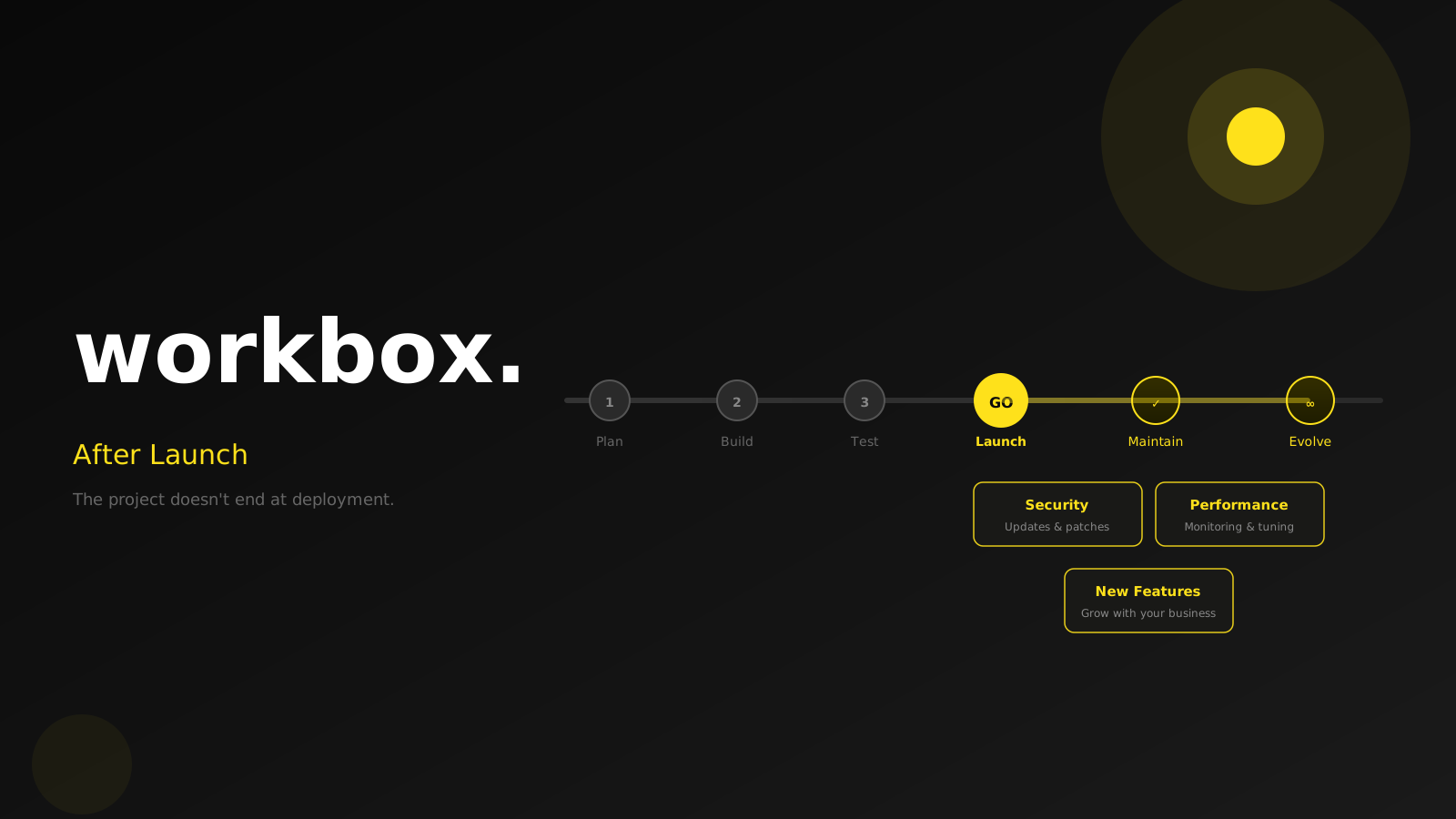
There is a moment that every software project shares: the day it goes live. The team celebrates, the stakeholders breathe a sigh of relief, and the invoices are settled. It feels like the end.
It is not. It is the beginning of a different phase — one that is just as important as the development itself.
Many businesses are surprised to discover that their new system requires ongoing attention after launch. This article explains what that looks like in practice, why it matters, and how to plan for it so you are not caught off guard.
What "maintenance" actually means
Maintenance is not a single thing. It covers several distinct types of ongoing work, each with its own rhythm and cost profile.
Bug fixes are the most obvious. Even a well-built system will have edge cases that only surface when real users interact with it at scale. Fixing these promptly is important — for user trust, data integrity, and in some cases legal compliance.
Security updates are non-negotiable. The software libraries and frameworks your system is built on receive regular security patches. If you are not applying those patches, your system accumulates vulnerabilities over time. This is not a theoretical risk — it is how the majority of data breaches happen.
Infrastructure and compatibility maintenance ensures your system keeps running smoothly as the environment around it changes. Operating systems update, browsers change, third-party APIs get new versions, and cloud services shift their pricing and capabilities. None of this requires you to change your software's features — but it does require someone to keep up.
Performance monitoring catches problems before your users do. Slow queries, memory leaks, and growing datasets all affect how responsive your system feels. Left unattended, they tend to get worse quietly until they become an emergency.
Further development: why software is never truly finished
Beyond maintenance, the more interesting category is ongoing development. This is where the real value of a well-built system becomes clear.
Your business changes. The process you automated two years ago may work differently today. A new product line, a new market, a new team structure, or a change in regulation can all create requirements your original system did not anticipate. The question is not whether this will happen — it is how ready your system is to accommodate it.
Your users give you feedback. Once real people use your system daily, they will find things that work differently than expected, steps that are slower than they need to be, and features they wish existed. This feedback is enormously valuable. Acting on it — iteratively, based on actual usage — is how software improves over time.
The market moves. Competitors add capabilities. Customer expectations shift. New technology creates new possibilities. A system that felt modern at launch can feel dated within two or three years if it does not evolve.
None of this means your software was built wrong. It means software is a living product, not a static asset.
The cost of neglect
The consequences of treating software as a one-time purchase and ignoring maintenance are predictable — and expensive.
Security incidents tend to be the most dramatic. A system running unpatched dependencies is a soft target. Recovering from a breach costs far more than the maintenance budget that would have prevented it.
Technical debt compounds. When small issues go unaddressed, they create constraints. Fixing one thing requires touching five other things that have grown fragile. Eventually, you reach a point where adding a new feature requires rebuilding significant parts of the system — not because the original build was bad, but because it was never tended.
User frustration grows quietly. People adapt to workarounds. They start to lose confidence in the system. They find ways around it, often involving spreadsheets or manual steps that undermine the efficiency gains you built the software to achieve in the first place.
Migration becomes necessary — but much harder. Many clients come to us after years on an unmaintained system, needing to migrate to something new. The problem is that the data is messier, the institutional knowledge of how things work has partly evaporated, and the business has grown more complex since the original build. Migration projects are expensive under the best circumstances; they are far more expensive when the system has been left to decay.
How to plan for post-launch from the start
The right time to think about maintenance and ongoing development is before a project launches — ideally before it is even scoped.
Budget for it explicitly. A common rule of thumb is that annual maintenance costs around 15–20% of the original build cost. This varies significantly depending on complexity, technology choices, and how actively you want to develop new features. Whatever the number, it should be in your plan.
Establish a support agreement before you need one. Trying to arrange emergency support during a live outage is stressful and expensive. A standing relationship with your development partner — even a lightweight one — means there is someone who knows your system and can respond quickly when needed.
Plan for regular review cycles. Rather than waiting for problems to force a conversation, build in quarterly or semi-annual reviews where you look at performance, security posture, and your development backlog together. This keeps things manageable and keeps your partner aligned with where your business is heading.
Separate maintenance from feature work. These have different rhythms, different urgency levels, and often different budget sources. Mixing them together makes it hard to plan either properly.
What a good maintenance partner looks like
Not every development company is equally good at ongoing support. Some are excellent at project delivery but prefer to move on once the system is live. Others specialise in long-term relationships and ongoing development.
Signs of a good long-term partner:
- They document what they build, so knowledge is not locked in individuals
- They proactively flag issues rather than waiting for you to notice them
- They help you prioritise your development backlog based on business value, not just technical interest
- They are honest about scope and cost, including when a request is larger than it appears
- They think about your system as part of your business, not just as code to be shipped
At Workbox, we treat post-launch as a natural continuation of the project — not a separate product. Our clients typically have ongoing agreements that cover both reactive support and planned development, with regular check-ins to keep priorities aligned.
The bigger picture
Launching a software system is a significant milestone. But the businesses that get the most value from their investment are the ones that treat launch as a beginning, not an end.
Software maintained well becomes a genuine competitive asset. It keeps pace with the business, adapts to new needs, and compounds in value over time. Software left to decay becomes a liability — and eventually a crisis.
The difference is not luck. It is a deliberate decision to treat ongoing development as part of how you operate.
Thinking about what comes after your next launch — or trying to sort out a system that has been left to drift? Get in touch and we will help you build a plan that makes sense for where your business is going.