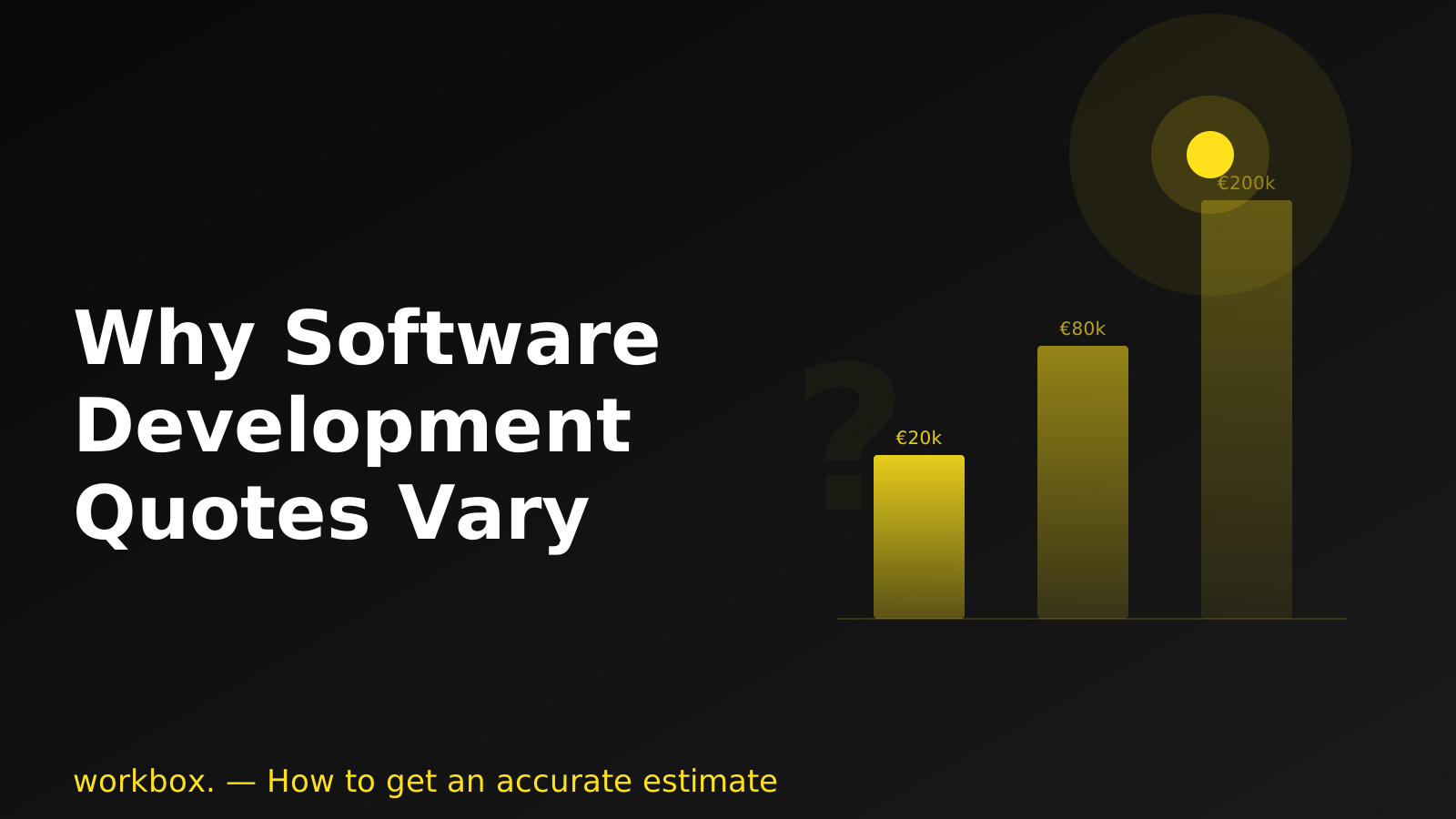
Getting quotes from software development companies is a confusing experience for most business owners. You describe what you need — a customer portal, an inventory system, a mobile app — and receive estimates that differ by a factor of five. Sometimes ten.
This isn't developers being evasive, and it doesn't necessarily mean one company is trying to overcharge you. It is what happens when different people interpret the same vague description differently — and then price their own interpretation.
Understanding why this happens is the first step to fixing it.
What you're actually asking them to price
When you send a brief to a development company, you're asking them to estimate the cost of something that doesn't exist yet, based on a description that is almost certainly incomplete.
Every software project is unique. Unlike renovating an office, where labour and materials have established rates, software involves a long chain of decisions — technical architecture, integrations, edge cases, security requirements, scalability — most of which aren't spelled out in a brief.
When the brief is vague, each company fills in the blanks with its own assumptions. One company assumes a simple database structure; another anticipates a complex one. One assumes integration with a single payment provider; another prices for three. The quotes reflect these different interpretations, not different skill levels or hourly rates.
What actually drives the cost (and what doesn't)
The biggest drivers of software development cost are often invisible in a brief.
Integrations. Connecting your new system to existing tools — an accounting platform, a CRM, a logistics provider — often costs as much as building the core system itself. Each integration has its own complexity, quirks, and potential for unexpected work.
Edge cases and error handling. What happens when a user does something unexpected? What if a payment fails halfway through? What if an uploaded file is in the wrong format? Handling these situations properly takes significant time — and clients rarely think to mention them.
User roles and permissions. A system with three user types (customer, manager, admin) is not three times the work of a single-user system — it's more like six to eight times the work. Access control logic touches everything.
Non-functional requirements. How fast does it need to respond? How many users simultaneously? Does it need to work offline? Does it need to pass a security audit? These requirements can double the project cost without adding a single visible feature.
Data migration. If you're replacing an existing system, moving data from the old one to the new one is often a significant project in itself — one that's easy to underestimate and hard to cut.
If none of these are specified in your brief, different companies will make different assumptions — and you'll get wildly different numbers.
Why the lowest quote is often the most expensive option
The lowest estimate you receive is almost never the cheapest option in the end.
There are three common reasons a quote comes in unusually low:
Optimistic assumptions. The developer assumed the simplest version of everything. When reality turns out to be more complex — as it usually does — the scope expands and the cost follows.
Quiet exclusions. Important parts of the project — testing, deployment, documentation, user training, post-launch bug fixes — were left out. You'll pay for them separately, later, under less favourable conditions.
Underpriced now, recaptured later. Once you're committed to a partner and deep into development, your negotiating position has changed. Change requests and small additions become disproportionately expensive.
None of this means low quotes are always wrong. Some companies are genuinely more efficient than others. But if one quote is significantly lower than two others from reputable companies, it is worth understanding exactly why before proceeding.
How to get quotes that are actually comparable
The most effective thing you can do is provide more detail upfront — not less.
A useful brief includes:
- What the system needs to do, described in concrete terms. Not "manage our orders" but "allow a customer to place an order, track its status, receive email notifications at each stage, and contact support directly from the order view."
- Who will use it, and in what roles. A customer-facing tool is different from an internal operations tool — even if the features seem similar.
- What it needs to connect to — existing software, APIs, third-party services. List everything, even if you're unsure whether it matters.
- How many users you expect, both at launch and eventually. Scalability assumptions affect architecture decisions.
- What happens with existing data, if you're replacing something. Outline what currently exists and where it lives.
- Any compliance or security requirements — GDPR, sector-specific regulations, internal IT standards.
- What "done" looks like — what does successful delivery actually mean for your business?
With this level of detail, quotes become meaningfully comparable. You're pricing the same thing, not different interpretations of it.
Fixed-price or time-and-materials: which to ask for
When requesting quotes, you'll encounter two main pricing models.
Fixed-price quotes give you certainty on cost upfront. They work well when the scope is clearly defined and unlikely to change. The trade-off: the development company builds a risk premium into the price, and the contract will define exactly what is and isn't included — change requests outside that definition will be charged separately.
Time-and-materials means you pay for actual hours worked. The final cost depends on how the project evolves. This model is more flexible and often cheaper when requirements change — which they usually do. The trade-off: you need to monitor progress and costs more actively.
Many projects use a hybrid: a fixed fee for the discovery and design phases (where scope is defined precisely), followed by time-and-materials for development. This gives you cost certainty where it matters most, and flexibility where it's needed.
What to look at when comparing quotes
When the estimates arrive, look beyond the headline number:
- Understand what is included. Does the quote cover testing, deployment, documentation, and training — or just writing the code?
- Understand how changes are handled. What happens if requirements shift during the project? What's the process and what does it cost?
- Check the timeline. A lower price spread over a longer delivery period might not suit your situation.
- Assess the process. How will you be kept informed? When will you see working software for the first time?
- Look at the team. Who will actually work on your project? What have they built before that's similar?
A quote is the beginning of a conversation, not the end of one. Good development partners welcome detailed questions — and their answers tell you as much as the numbers do.
If you're preparing to commission software and want help turning your idea into a brief that gets accurate, comparable quotes, talk to us. We'll help you think it through before you put it in front of anyone else.